

My first Jishuken: improving delivery performance at an injection parts supplier
FEATURE - A first Jishuken at a struggling injection parts supplier reveals how MIFA, PCC, and mizusumashi transformed push scheduling into pull flow—reducing delays and revealing Lean's real lesson: developing thinkers, not just deploying tools.
Words: Teuku Mirwan
Building better suppliers has always been one of the core objectives of the Toyota Way. Toyota believes that strong suppliers are essential to creating stable flow, high-quality products, and reliable delivery performance across the value chain.
One of the practical methods used to develop supplier capability is Jishuken, a hands-on self-learning workshop where teams, guided by experienced sensei, analyze real problems and improve their own processes through learning by doing. The goal of Jishuken is not only to achieve immediate improvement results, but also to build people’s capability to think, solve problems, and apply continuous improvement principles independently.
I still remember when my first sensei, Minagawa-san, invited me to support one of Toyota’s injection interior parts suppliers that was struggling with delivery performance problems. At that time, I was just starting my lean journey, and this opportunity became my first real opportunity to get a deeper understanding of Lean Thinking at the gemba. It was not only about using lean tools, but about learning how to understand the value-driven purpose, improve the process, develop capabilities, build a proper management system, and apply the right basic thinking to solve the operational challenges.
The success of this Jishuken later became an important milestone in my learning journey — as well as an important part of my master’s degree in industrial engineering, as I published the results of the experience together with my colleague and professor in an academic journal
). Years later, when I learned about the Lean Transformation Framework, I realized that Jishuken had already followed the same logic and structure.
In this article, I would like to revisit my experience and share the story using the Lean Transformation Framework’s five key questions as a reflection of my first steps as a student of Lean.
1. What problem were we trying to solve?
The Injection Part Supplier was experiencing serious customer complaints, with around 12% of total deliveries delayed. This directly impacted customer satisfaction and supply chain stability. As supplier, delivery reliability was a critical requirement, and any delay could disrupt the downstream production process and weaken trust between the supplier and customer. Some assumptions were raised (such as high customer demand, limited production capacity, and scheduling challenges), but there was no structured understanding of how these issues connected.
From a lean perspective, this situation showed a clear gap between customer demand and the supplier’s ability to deliver value consistently. After observing the real work, the situation became much clearer. The delivery problem was driven by a mismatch between customer demand and production capacity, unstable and ineffective production scheduling, and process-specific bottlenecks. The combination of limited machines and manpower, high variety of interior part orders, long changeover and setup times, and poor synchronization between processes created an unreliable production system. Production schedules were frequently adjusted, parts were not always available when needed, and coordination between departments was weak, leading to frequent delays and reactive decision making. This direct observation helped us understand that the real problem was not only delivery delay itself, but the lack of a structured production control and coordination system that could stabilize flow and ensure on-time delivery to the customer.
2. How did we improve the process?
To understand how delivery performance could be improved, we first needed to clearly understand the production process and how value was flowing from incoming material to shipping. Each process had its own operational challenges, and coordination between processes was critical to ensure smooth delivery to the customer. During the Jishuken, instead of using the commonly known Value Stream Mapping (VSM), Minagawa-san introduced us to MIFA (Material and Information Flow Analysis) to deeply observe how materials and information moved across the entire production system. Through MIFA, we analyzed the real production flow, information flow, scheduling practices, and process interactions to understand where delays and inefficiencies were happening in the system.
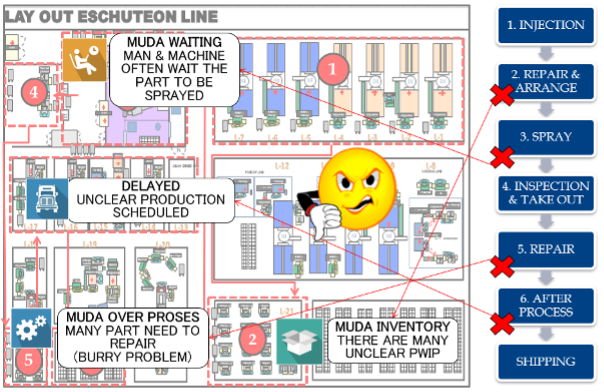
The MIFA revealed several critical issues in the production flow, and during the observation we were also able to clearly identify several types of waste (muda), such as waiting, overprocessing in the form of rework and repeated inspections, excessive inventory between Injection and Spraying, and delayed material movement that disrupted the overall production flow.
In the Injection process, long setup times made it difficult for machines to frequently switch between different customer orders, especially because they were dealing with high product variety and small batch sizes. Trying to follow daily customer demand directly caused excessive machine stoppages and unstable production scheduling. In the Spraying process, production often stopped because it had to wait for parts from Injection, showing an obvious lack of synchronization between processes. As a result, the overall flow from Incoming Material to Shipping became unstable, with parts frequently waiting between processes and production decisions made reactively. This situation was further complicated by limited machines and production capacity, which made it difficult to respond quickly to fluctuating daily customer orders. From this observation, we identified three major root causes:
- High variety of customer orders with small quantities causing frequent changeovers.
- Limited production resources that could not manage fluctuating demand efficiently.
- Poor scheduling and priority decisions between Injection and Spraying that created bottlenecks and waiting time.
To address these problems, the team introduced a Part Control Centre (PCC) as a bridging and coordination point between the Injection and Spraying processes. The PCC designed to manage work-in-process (WIP), control material flow, and ensure better production prioritization. Instead of sending rigid daily production schedules, the Production Control team began providing export lists for today, the next two days, and the next three days, allowing more flexibility in production decisions. The PCC then managed inventory between processes using supermarket and FIFO principles, ensuring that Spraying always had the necessary parts without waiting for Injection. This approach allowed Injection to run more stable production cycles while Spraying could operate based on actual needs, reducing waiting time and improving synchronization. As a result, production flow became smoother, resource utilization improved, and the company was able to respond more effectively to customer demand while reducing delivery delays.
3. What capabilities did we need?
One important capability gap identified during the Jishuken was the absence of a dedicated person responsible for controlling and delivering parts between processes. Minagawa-san introduced the concept of mizusumashi, often known as a “water spider” in lean jargon. A mizusumashi is a multi-skilled operator responsible for supplying materials, moving parts between processes, and ensuring smooth material flow without interrupting production activities. The role is critical in maintaining flow, reducing waiting time, and supporting synchronization between processes. In this injection part supplier, there was no such role, which caused poor visibility of WIP, frequent rush conditions in the operation department to fulfil export lists from the production control department, weak scheduling coordination, and limited flexibility in responding to changing customer demand. As a result, departments worked in isolation, production decisions were reactive, and parts often arrived too late or too early, creating instability in the production system.
To build the necessary capability, we focused on developing both people understanding and operational coordination. The production control department was coached to go to the gemba and understand the actual WIP condition in the PCC before creating export lists, ensuring that scheduling decisions were based on real production conditions rather than assumptions. The export list system was redesigned into today, next day, next two days, and next three days planning, allowing for more flexibility and better coordination with operations. A dedicated mizusumashi was assigned to follow this new export list strategy and ensure that parts were delivered smoothly between Injection, PCC, and Spraying processes. In addition, the PCC supermarket strengthened with barcode scanning to track part movement in and out, improving visibility and control of inventory. Through these improvements, the company developed stronger capability in production control, scheduling coordination, material handling, and real-time decision-making, which supported more stable production flow and better delivery performance.
4. What management system and leadership behavior were necessary?

The improvement of the PCC and mizusumashi system required a meaningful change in how the production control department and operational leaders managed daily activities. Previously, production control focused on sending rigid daily export lists and pushing operations to fulfil delivery targets, which often created rushed conditions and reactive decision-making on the shop floor. As shown in the new export management system (see figure above), the production control department shifted its approach by providing a more flexible export list structure (today, next day, next two days, and next three days) and coordinating closely with PCC and operations to ensure that production decisions were based on actual conditions at the gemba. This new system transformed the way information and requests flowed across processes, replacing manual and reactive coordination with a structured request system between production planning, PCC, mizusumashi, and operational leaders.
At the same time, leader behaviors also changed significantly. Previously, leaders focused on chasing delivery results and pushing teams to meet export targets, which meant they were managing lagging indicators such as delayed delivery performance. Through the Jishuken, leaders learned to shift their focus toward leading indicators, especially PCC stability and mizusumashi performance.
The new mindset was simple: if PCC could consistently fulfil part requests from the next process and align with the export list provided by production control, then delivery performance would naturally improve. This created a new management system where production planning, mizusumashi, PCC, and operational leaders connected through daily coordination, visual control, and structured request signals from downstream processes. Leaders were no longer just pushing results but were actively managing flow, supporting coordination, and ensuring that the system worked smoothly, creating a more stable and sustainable delivery performance.
5. What was the basic thinking like?
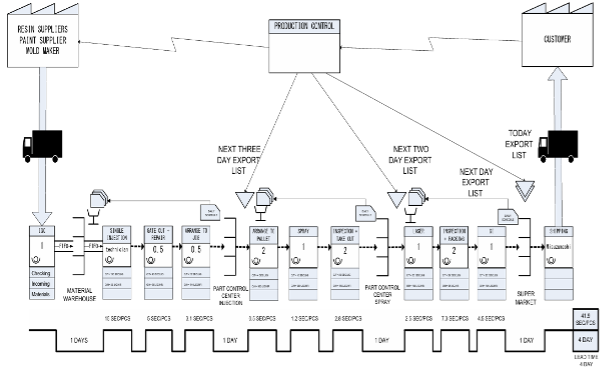
The future-state VSM (see figure above) illustrates how the new injection company production system was designed to operate following the Jishuken improvements. The new system shows a clear and structured flow of both material and information, starting from Production Control through the export list strategy and continuing to Injection, Spraying, Inspection, and Shipping with strong coordination through the PCC.
Instead of relying on manual requests and reactive scheduling, each process now receives clear export lists (Today, Next Day, Next Two Days, and Next Three Days) and works based on actual customer demand. The PCC functions as a supermarket and coordination hub, supported by mizusumashi to ensure smooth material movement and synchronization between processes. This future-state design reflects a stable pull-based production flow where materials move only when needed and information flows transparently across processes, reducing waiting time, overproduction, and delivery uncertainty while improving responsiveness to customer demand.
The basic thinking behind this transformation was not simply the application of lean tools, but also a deep commitment to understanding the real work at the gemba and a collective effort to solve problems using Lean. The team shifted from a push system driven by internal schedules to a pull system driven by customer demand through structured export lists and clear information flow across Injection PCC, Spray PCC, and the supermarket. This approach demonstrated that Lean is not about copying tools such as VSM, pull systems, mizusumashi, supermarket, or kanban signals, but about understanding the purpose, observing the real condition, and tailoring solutions to fit the operational reality. By practicing this basic thinking together, the team was able to create a unique and practical lean application that stabilized delivery performance and built a stronger foundation for continuous improvement.
SOME REFLECTIONS
This Jishuken experience was more than just a project to improve delivery performance; it was a complete learning experience that shaped my understanding of Lean (and that, I later discovered, aligned perfectly with the Lean Transformation Framework).
Starting from a clear problem in delivery performance, the team worked together to understand the real purpose of creating stable flow for the customer, deeply observed the process through gemba walks and MIFA, developed people capabilities through hands-on learning and collaboration, built a structured management system through PCC and mizusumashi coordination, and applied the right basic thinking by shifting from push to pull and focusing on leading indicators.
This experience strengthened my belief that Lean is not about implementing tools, but about developing people and systems that can continuously solve problems and create value. Looking back at the first time Minagawa-san invited me to join this Jishuken, I now understand that this was the moment when I truly began my lean journey by learning directly at the gemba, guided by a sensei, and experiencing how the Toyota Way builds strong suppliers by developing strong thinkers and problem solvers.
THE AUTHOR

Read more


SEEN FROM OTHERS – Another interview in our series on how lean is perceived from the outside. This month we talk to an urban strategist to see if and how lean can contribute to transforming our cities.

VIDEO GEMBA WALK - Last week PL went to Brazil. We joined a doctor at the gemba in one of the hospitals we visited and asked her to show us their visual management system in the ER.

CASE STUDY – By leveraging Daily Management (DM), Supergasbras was able to change its trajectory and add more value to the customer in a critical sector for society.

FEATURE – An approach based on coaching and experiments is transforming the way restaurant chain Xibei works with its people to improve service and dishes: the story of Chef Liang and his Kongfu fish.
Read more
INTERVIEW – A team from LGN just spent a week on the gemba with Toyota veteran Hideshi Yokoi for a jishuken exercise. We asked him to explain to us how he used this practice while at Toyota Motor Kyushu.
VIDEO - In February, a group of Lean Global Network coaches visited Coloplast's Parts Distribution Center in Hungary to help the local team improve the internal lead-time across the facility.
FEATURE – In March 2019, this hospital partnered with the Lean Global Network on a two-day Jishuken event. Nearly two years later, the authors reflect on the legacy of that initiative.
CASE STUDY – This Indonesian nickel smelter used Lean to stabilize furnace operations by reducing excess carbon in calcine through root-cause problem solving, automation, and operator-driven improvements at the gemba.