


5S your mind – Thinking beyond the tools
FEATURE - Using 5S thinking beyond tools, the article explores how mental clutter, assumptions, and habits create waste—and how structured problem-solving restores clarity.
Words: Tshepo Thobejane
The mess on the left started with one box of books bought at a clearance sale by one of the major local bookstores. I intended to unpack the books into the bookshelves in the study but something else took my attention and I thought that I would do it the following weekend. When the weekend came, I had other things that took my attention. Weeks and months passed and I found other book sales and the number of boxes increased. Over time, the boxes became storage space for other items beyond the books.
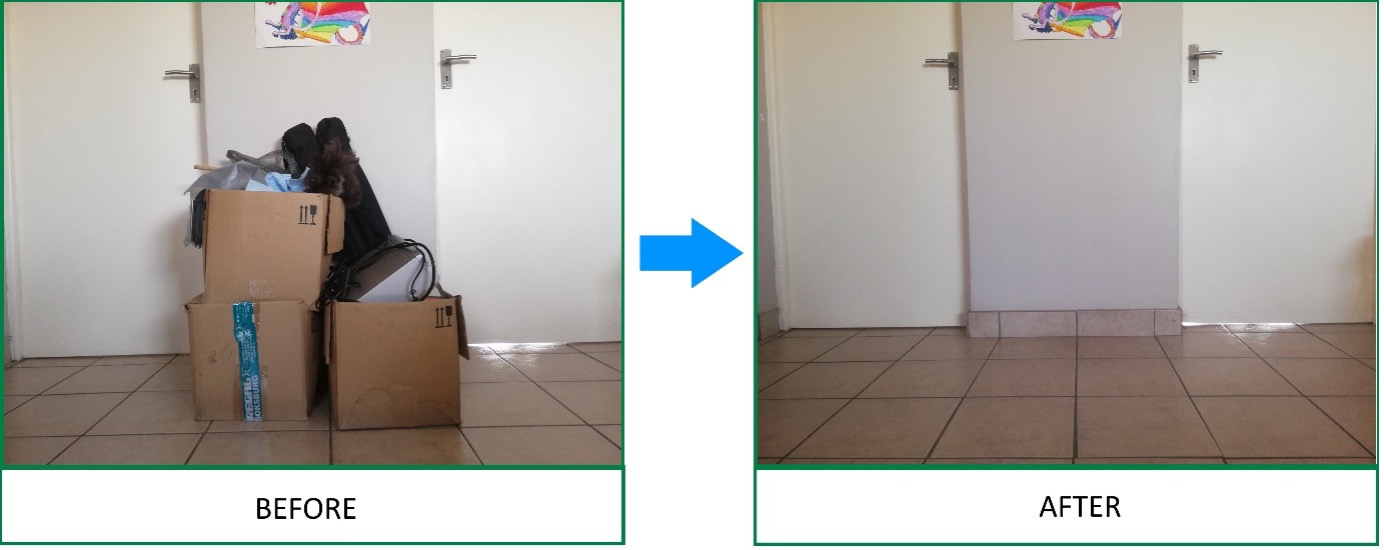
It seemed like I became blind to the existence of the boxes or their impact. When moving in the house I had to walk around or be mindful not to bump into the boxes. I also had an extra task of moving the boxes up and down when cleaning the floors. On occasions when I was lazy, I would just clean around the boxes and dust would accumulate on the floor underneath the boxes. Fortunately, and months later, sanity prevailed. I thought: “Why don’t you practice what you preach ‘Mr Lean Practitioner’? And please, reflect on this experience. Your personal experiment for the Lean community!”
The obvious effect and impact was that my space became an eyesore, which needed some explaining away for curious guests. But going deeper than that, this experiment showed me how we become blind to the abnormalities when we leave them unresolved over an extended period of time. Workarounds and waste (extra time, effort and motion spent moving the boxes) became the norm. This demonstrated the benefits of 5S and quick response to deviations from the standards/targets. But I would like us to look beyond the physical and obvious benefits or application of 5S. The deeper question to me was: “How could 5S play out or relate to the mental space, specifically for problem-solving?”
Clutter and disorganization in physical spaces are easier to see and correct than in the mental space. In addition, the relationship between the physical and non-physical is interesting. How we manage, create and interact with the physical space is not random, because it reflects the state or contents of our mental space. Interestingly, some of the models used to illustrate Systems Thinking, Lean or TPS acknowledge this through the inclusion of mindset, philosophy, or basic thinking as the foundation of these models.
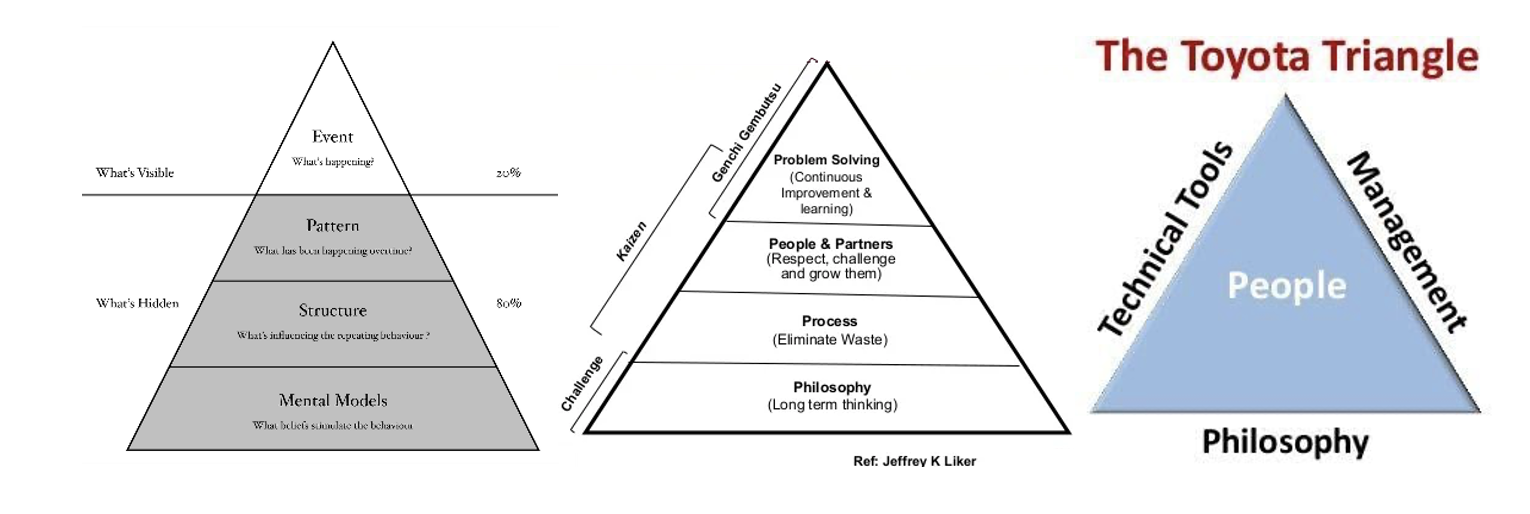
We could say that these models confirm that the physical world is built upon or governed by the mental world. Therefore, if we encounter problems or challenges in the physical world, we need to investigate the philosophy, beliefs or mental models guiding our actions in that area.
In addition to looking at their relationship, it may be worthwhile to note the difference between the physical world and mental world. The physical space is governed by scarcity (we have limited resources and space). When it comes to the mental space, we could say that it is the combination of the limited and unlimited. Infrequently used content or undesired content is shifted to the unlimited subconscious mind (our dynamic and expandable long-term ROM space) in order to free up the capacity of the limited conscious mind (our active and short-term RAM space).
In his book Thinking, Fast and Slow, Daniel Kahneman brought our attention to the concept of two mental processes that we use for making judgments and decisions. System 1 is the fast-thinking system that is automatic and operates with little or no effort. System 2 is the slow thinking system that uses more mental effort and is deliberate. Since we are less aware of the fast-thinking processes (System 1), we could deduce that their operations consume less of our RAM capacity (attention and active mental effort) and rely more on our ROM space, which holds and manages our stored mental programs (beliefs, habits and mental models). On the other hand, System 2 processes are demanding and use a lot of our RAM capacity, since they are used in those moments when we realize that the automatic programs stored in our long-term memory (ROM space) cannot adequately address the problem at hand.
The fast-thinking mental processes operate with less attention to detail, trusting the validity of assumptions and beliefs that trigger and run the stored programs in our long-term memory (subconscious). Having an infinite capacity, our subconscious has stored many beliefs over the years—some true and some with half-truths. We might be holding on to concepts that worked in the past but may create negative unintended consequences because conditions have changed in the current environment. In the physical world, it is easier to see and identify when things are out of place or missing, but this is not so easy with the mental world. It is therefore possible that we are holding onto many assumptions and beliefs that are out of touch with our current reality. The presence of such beliefs and assumptions creates workarounds and waste in our daily lives without us realizing it. With everything said, applying 5S to our mental world will therefore focus on making time to identify faulty assumptions and beliefs that direct our daily actions.
Here is how I think we can adapt and transfer the concept of 5S to our minds and problem-solving:
- Sort – Separate the essential from non-essential. Some questions include: What is fact versus assumption? What is relevant versus not relevant for the problem at hand? What do I know and what do I need to know?
- Set in Order – Organize data and facts according to relevant categories and follow a logical process to uncover the dominant cause-and-effect mechanisms. This includes moving from data to information to key trends and then determining causality.
- Shine – Regularly collect feedback and assess if any of the key conditions about the environment that are relevant to existing solutions and problem identification have not changed.
- Standardize – Train others to ensure that solving problems in our environment has a standard language, process and quality checks to ensure alignment with other stakeholders.
- Sustain – Engage with other disciplines to learn and share how principles apply in different but interrelated environments. Celebrate progress. Reward yourself and others for growth and improvement.
None of us really have an idea of just how many faulty assumptions we operate with daily. If we were to use the words of the ancient Chinese philosopher, Lao Tse, as a guide, we might discover that we are running with more faulty assumptions than we realize. In Tao Te Ching, he wrote: “To attain knowledge, add things every day. To attain wisdom, subtract things every day.” Let’s use structured problem-solving methods to 5S our minds and remove the faulty assumptions that create unnecessary workarounds and waste in our lives.
THE AUTHOR

Read more

INTERVIEW – Planet Lean speaks with telecommunications company Telefónica about the organization's attempt to apply lean startup principles in its R&D department.

FEATURE – What a Brazilian bank has learned from its first few steps in adopting hoshin kanri through structured problem solving and people development.

RESEARCH - In the last 10 years lean has made its way in many hospitals and healthcare systems, often with impressive results. Professor Dan Jones looks back at the lessons learned throughout the decade.

VIDEO - In February, a group of Lean Global Network coaches visited Coloplast's Parts Distribution Center in Hungary to help the local team improve the internal lead-time across the facility.
Read more

FEATURE - Mental schemas help us to process information, but they often lead us to blindly jump to solutions without understanding the problem. Here, the author explains how Lean Thinking mitigates that risk.

FEATURE – Using Carol Dweck’s distinction between fixed and growth mindsets, the author discusses how leaders should think and act to make lean possible. Looks like no fixed mindset is beyond saving.

ARTICLE - A-ha moments... we have all had one at least. In this personal account, the author reflects on what his own experience has taught him about changing our mindset and being stuck in our ways.

FEATURE - The Basic Thinking dimension of the Lean Transformation Framework is often the most neglected and the least understood. The author tries to shed a light on the subject.