


Just say the word: Ego
FEATURE - In this series based on his latest book What’s Lean?, Michael Ballé explains lean terms, from the most common to the least known, to uncover the meaning and thinking behind them.
Words: Michael Ballé
Roberto Priolo: It's interesting how some of the terms you included in the glossary are not lean-specific. "Ego" is one of them. Just like it applies to many situations in our daily lives, it plays a huge role even in our lean transformations. How hard is it to navigate the fine line between leveraging one's ego to feed the ambition of a lean journey and giving in to toxic, self-serving leadership?
Michael Ballé: Ego is the inner belief, if not absolute conviction, that you matter more, that what you do matters more, and that you’re “more right” than other people. It tells you that your needs, opinions, and actions carry extra weight compared to everyone else’s. Driven by ego, one feels justified putting oneself first even when it’s unfair. You may think it’s fine to skip the line, interrupt others, or push their own way of doing things, because you feel your time or view matter more. Ego creates a sense of entitlement of “I deserve priority.” And this is a necessary aspect of getting things done—as well as of making enemies.
Change at the gemba means changing something, for real. It's concrete, not abstract. It means asking people to look again at what they do every day. Most collectives, however, naturally resist this. Teams rely on familiar routines, established processes, and shared habits. This organizational inertia reflects the collective preference to keep doing things the way they’ve always been done, because that feels safe and proven: it won't challenge anyone out of their own comfort zone. When someone questions it, people can react emotionally, with defensiveness, frustration, even anger, because their competence and identity feel challenged.
Without some ego, a person on the gemba would simply conform to the group and accept the current way as fixed. Ego provides the self-belief to trust your own observation: to notice waste, problems, or improvement opportunities that others overlook or prefer not to see. It gives you the courage to say, “This could be better”—even when the surrounding system pushes back. With your back to the wall, ego is the force that lets you think independently and challenge the status quo. It helps you insist on looking directly at reality and asking others to do the same, especially when they would rather not. The difference is not the presence of ego but how it is used: not to put yourself above others, but to hold your ground long enough to help everyone see and improve.
Unfortunately, the same inner drive that lets you stand your ground and challenge habits can easily spill over into how you treat people. When you’re convinced you’re seeing something important that others resist, it’s very easy to push just a bit too hard, belittle, speak too sharply, or dismiss concerns too quickly. In those moments, ego stops being quiet self-belief and turns into impatience (“Why can’t they see this?”), and you come across as a jerk.
On the gemba, this is almost an occupational hazard. You’re often asking people to question routines they trust and to change work they feel ownership over. Tension is normal. If you care about improvement and feel urgency, you will occasionally overshoot—press too far, challenge too bluntly, or underestimate the emotional impact on others. Ego supplies the force behind that push. The question is how to accept that you’re occasionally being a jerk without letting yourself be one all the time. A jerk from time to time, but not full-time a-hole.
Arguing for improvement inevitably creates conflict. The moment you question how things are done, you disturb routines, roles, and sometimes people’s sense of competence. Even when the intention is positive, others experience it as pressure or threat. So bringing conflict is not a mistake or a failure of approach—it’s part of engaging with reality and change.
The real skill is what happens after you create that disturbance. If ego only pushes, it stays blind to the impact on others: the confusion, loss of confidence, fear of looking wrong, or fatigue from repeated change. From the inside, these reactions can look irrational or self-inflicted, yet for the person living them they are real. They have to let go of something familiar before they can adopt something new, and that has an emotional cost.
The trick is in managing the conflict you bring by staying aware of that human side. It means recognizing that resistance is rarely just stubbornness; it’s often protection of identity, pride in craft, or anxiety about capability. So, instead of dismissing reactions as absurd, you try to understand what makes the change hard for that person. Where do they feel exposed? What do they fear losing? What skill or reassurance do they lack? What do they look at that I can’t see? From there, improvement becomes accompaniment rather than imposition. You still hold the challenge—the need to see differently and improve—but you also support the person through the discomfort it creates. You listen, you acknowledge the difficulty, you break change into steps, you help them succeed in small ways that rebuild confidence. In this sense, ego starts the conflict by insisting on seeing and changing; maturity manages it by taking responsibility for the human consequences and helping others through them.
Clearly no magic wand here and, as Will Smith said at the Oscars after punching an offending comedian, “At your highest moment, be careful—that’s when the devil comes for you.” Keeping one’s ego in check is not a solution, even if it were possible. Facing the consequences of what you do driven by ego, striving hard to find a better way, and becoming aware of your own repeated mistake is, I believe, the way of kaizen. The trick is to gain some measure of wisdom on the yin-yang nature of ego. The brightest flame casts the deepest shadow, so ego will get you to strive and move forward as well as try to convince you that you were right and collateral damage is unavoidable because you can’t make an omelet without breaking some eggs. That latter part is never true, it’s the dark ego speaking. Knowing this, all we can do is learn to breathe, keep our emotions in check, and accept that of others when their ego gets triggered.
Ego is the force that lets someone think independently and challenge the status quo. It helps you insist on looking directly at reality and asking others to do the same, especially when they would rather not. The difference is not the presence of ego but how it is used: not to put yourself above others, but to hold your ground long enough to help everyone see and improve.
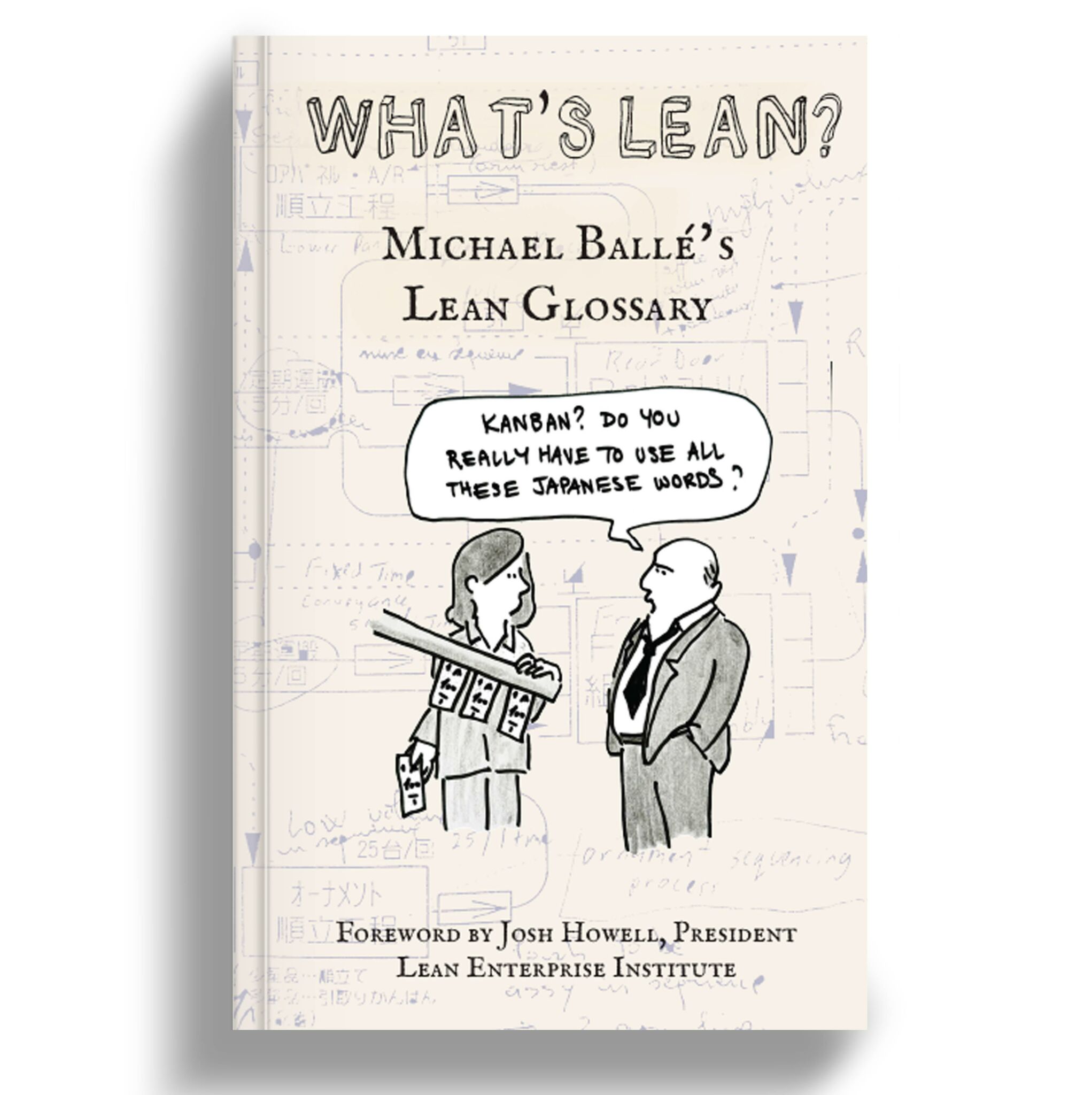
Roberto Priolo: Tell us about the comic accompanying this definition. How often do you encounter this kind of attitude in the leaders you work with?

Michael Ballé: Oh, man, every day—and I plead guilty to it as well. I believe the phrase is, “Mistakes were made (but not by me).” It’s incredibly hard for any of us to admit we were wrong. When improvement work exposes a mistake, a flawed assumption, or a suboptimal habit, it doesn’t just question a process—it touches the person’s sense of competence and judgment. Pride naturally resists that. We all want to see ourselves as capable and reasonable, so acknowledging error can feel like a small loss of status or self-respect.
Beyond pride, there are numerous studies showing that we all suffer from cognitive dissonance, the instinct to hang on to our beliefs rather than admit new facts. For example, if I chose a method and later evidence shows it causes problems, I hold two conflicting ideas: “I’m competent” and “I made a poor choice.” That inconsistency is uncomfortable, so the mind tends to reduce it by defending the original belief—explaining away the evidence, minimizing the issue, or questioning the new data—rather than revising the self-image. In other words, it often feels easier to reinterpret reality than to accept that “I was wrong.”
On the gemba, asking people to see problems in their own work is emotionally charged even when no blame is intended. What looks like denial or stubbornness is often the combined effect of pride and dissonance reduction. Understanding this matters because it shifts how you manage the conflict you bring. Instead of pushing harder for admission, you make it safer to revise one’s view: separating the person from the mistake, framing discovery as learning rather than fault, and sharing responsibility for seeing the issue. Our confirmation bias makes us look for all the reasons that although we were just proved wrong, really, in the end, we were right.
Executives perform in front of an audience—their teams, peers, bosses, boards, sometimes the market. Their words and reactions are constantly interpreted as signals of competence, confidence, and control. In that setting, admitting that “I was wrong,” showing strong emotions or accepting help can feel risky, because it may be read as weakness or loss of authority. So many leaders develop a protective stance. They project certainty, stay composed, and maintain the appearance of self-sufficiency. This is not necessarily arrogance; it’s often adaptation to expectations placed on leadership roles. If they reverse a decision or reveal doubt, they worry about eroding trust or inviting challenge. The higher their position, the more visible the audience and the stronger this pressur. In such a scenario, leaders won’t admit to being wrong, show emotion or accept help, to the point that, from the sidelines, it’s often comic (not to the people working for the guy, of course… the boss might not always be right, but the boss is always the boss).
All this to say that in improvement work, ego and inertia are the two sides of the same coin, the two dancers in an on-going tango. Taiichi Ohno himself devoted the first 20 pages of Workplace Management to realizing one was often wrong. In his words, if even a thief is right three times out of ten, we shouldn’t be surprised if we’re wrong at least half the time. And then admitting it, on the spot, and moving on. Admitting that you were wrong causes a moment of embarrassment. Sticking to a mistake can have disastrous consequences and sometimes lead to a lifetime of remorse. So know your ego, and ride that horse rather than let the horse run you.

Read more


WEB SERIES - In the last episode of our It's a Lean World series, we travel to the tip of South America to visit the southernmost Distribution Center in the world and learn about its lean work.
CASE STUDY – The authors discuss how rooftop window producer VELUX harnessed Lean Thinking and Industry 4.0 to empower shop floor workers, after rediscovering the kaizen spirit following a digitalization initiative that didn’t work out.

FEATURE – In the face of uncertainty, when it’s hard to see the road ahead, we can still make things better day after day by embracing kaizen – until we are out of the woods.

CASE STUDY – Clinical trials are known for their rigorous analysis and approval process. The experience of Roche Brasil teaches us what lean and agile thinking can do to speed it up.
Read more
FEATURE - In this new series based on his latest book What’s Lean?, Michael Ballé explains lean terms, from the most common to the least known, to uncover the meaning and thinking behind them.

CASE STUDY – The story of how a humble leader, who recognizes the importance and contribution of each individual to the company’s success, is making a car dealership in Botswana a fantastic example of lean transformation.

FEATURE – The authors share the main insights from a webinar with two Toyota leaders from South America, on the leadership practices that have allowed the company to sustain results for decades.

VIDEO – We constantly talk about the role of leadership, but perhaps we don't realize just how intertwined leadership transformation and business transformation really are. This short video discusses why.