

The room has to change first
MY AHA MOMENTS – The author recalls a lean transformation that stalled until leaders confronted the culture of blame in the company—a precondition for surfacing mistakes and improving processes.
Words: Daniel Halvarsson
“We have a problem.”
The sales manager's voice on the phone was tight. I had been pushing engagement for months. I knew her well enough to hear it.
“What is it?”
“You know I've been encouraging my team to open up about mistakes and submit improvements. I finally got a good one from the order department yesterday. An employee there flagged a flaw in the process and described where she'd been getting it wrong. She put her name on it.”
“And?”
“This morning someone else logged a new improvement in the same system. The improvement they suggested was that she should learn to do her job and stop making mistakes. They wrote her name for everyone to see.”
I sat at my desk for a moment after the call ended, thinking. We had been at the new Swedish manufacturer for around a year. It was very much a transformation in motion. I had been hearing a lot of ideas. In passing, on the floor or in the office, people mentioned things—frustrations with how something was set up, fixes someone had thought about. Good ideas existed, but they weren't reaching us in an organized way.
We had the morning huddles in place, but improvement ideas never surfaced there. We had a non-conformance and improvement suggestion system; I had assumed people needed something private, even anonymous. With no suggestions coming in, I told myself it was a usability problem, so we made submission simpler. I pushed for it in every meeting. Six months later, the system was still mostly empty, besides a few generic items a month. A part loose on a truck. A late shipment from a supplier. A handling error at a customer site. Things that happened to us, but never our own mistakes. None of my theories on why the system didn’t work had been correct. It was that phone call that opened my eyes.
A woman in the order department had raised her hand to say she had made a mistake, suggesting how we could fix the issue. The answer she got was her name in a public box, framed as the problem that needed solving.
I went to find her the following day. We talked in a quiet corner. The post in the system was just the tip of the iceberg. The day after, the person who wrote it sat at her lunch table and openly discussed her mistake in front of the people she ate with. We realized the plant had been running on public shame for years, and everyone had learned to keep their heads down. The woman was new and had not learned the rule yet. She told me without anger: “I just wanted you to know what happens here.”
I had spent the last six months asking people to raise problems and flag up mistakes. The problem is that I had been asking people to be vulnerable within a system that punished vulnerability, without spending a single hour asking what happened to the ones who tried. Watercooler chats had not been a sign that psychological safety existed; they were a sign that such conversations were only possible in an informal, often intimate setting.
I brought the incident to my management team a few days later, expecting alignment on what had been on my mind since the call. We needed to stop creating blame and start building the psychological safety that lets people surface real things. One of the managers—among the longest-serving in the company and still the loudest in every meeting—got stuck on the woman's original mistake. He wondered out loud whether we had hired the right person, without realizing he had just exposed the root cause of the problem.
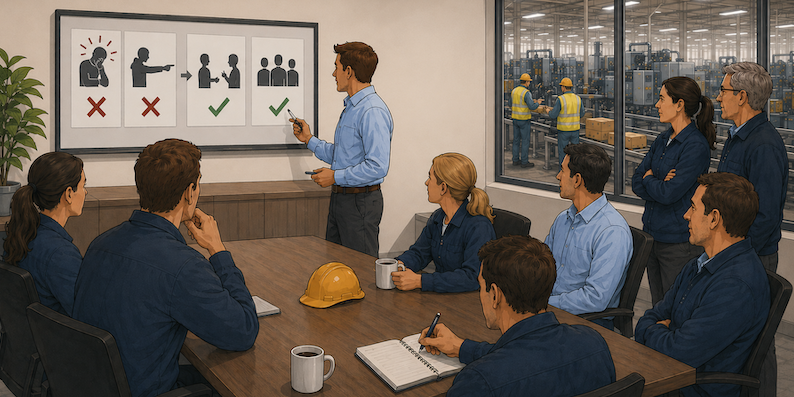
That was the moment I stopped pushing for improvements and error reporting. Before asking anyone else to surface another problem, we worked on the room—the management team, that is. All top leaders sat together for a day, not to recite the company values and behaviors but to discuss them, through real cases from our operations, until there was specific agreement on what each of them meant in practice, and what would count as breaking it. We did the same once more with team leaders and the managers, to get alignment across levels. Without that, you get as many interpretations as you have leaders, and the floor reads the gap every time. Every leader then signed a charter, which we printed out and posted where everyone who had signed could see it. We also changed one small rule: no submission could name an individual. The focus had to sit on the process, instead. It hadn’t occurred to me to introduce such a rule, and that was on me.
The shift did not happen at once. However, the reporting system gradually went from a few generic items a month to a steady flow of process failures we could fix. People started flagging costly mistakes they would never have put in writing previously. The clearest sign that things had changed came when a long-tenured employee, who had experienced the shaming culture we had in place, flagged a mistake that had cost serious money. That single report uncovered a process failure that had been there for years but no one had dared bring up. We had stopped extracting engagement from a frightened room and started building one in which people would feel comfortable speaking up.
Since then, I have worked with many different organizations and seen a similar pattern everywhere. We start with what looks like the work— methodologies, routines, and systems. However, lasting change comes from what is harder to see: how leaders behave when mistakes happen, and what people feel when they speak up. Psychological safety is not a poster on the wall, nor a quick fix. It starts with leaders agreeing what the company's values and behaviors mean - not buzzwords, but decisions about how people are treated when things fail. I worry we keep launching systems for surfacing problems, before we have done the slow, unglamorous work of making the room safe enough to hold them. And the people who finally raise their hand keep paying the price for our hurry.
THE AUTHOR

Read more

NOTES FROM THE GEMBA - We follow the author on a visit to a train maintenance center in France. Through practical examples and pictures from the gemba, she explains how the center is transforming itself.

FEATURE – Much has been said and written about Toyota’s ability to recover from disasters. What many don’t realize, however, is that the company’s recovery strategy is informed by its underlying values – not just its tools.

FEATURE – The only way for lean to succeed is to change a leader’s behavior so the rest of the organization will change too and people get the support they need to become problem solvers.
FEATURE – The belief that standardization kills creativity can be a severe hindrance in a lean transformation. The author discusses how he convinced his team of architects to give standards a try.
Read more

MY AHA MOMENTS – In the second article of his new sieries, the author addresses the hidden cost of multitasking, explaining why focus—and not constant activity—drives real productivity.

FEATURE – What is psychological safety? What is it not? This article explores its advantages and foundational elements, and how organizations need to transform their leadership to achieve this evolution in management.

MY AHA MOMENTS – Opening a reflective new series on his lean “aha” moments, the author recalls discovering the power of gemba observation to reveal hidden capacity without investment.

FEATURE – The authors share the main insights from a webinar with two Toyota leaders from South America, on the leadership practices that have allowed the company to sustain results for decades.