

Embrace not knowing
MY AHA MOMENTS – The author reflects on how embracing uncertainty, curiosity, and systematic problem solving can overcome resistance to Lean and create a culture of continuous improvement.
Words: Daniel Halvarsson
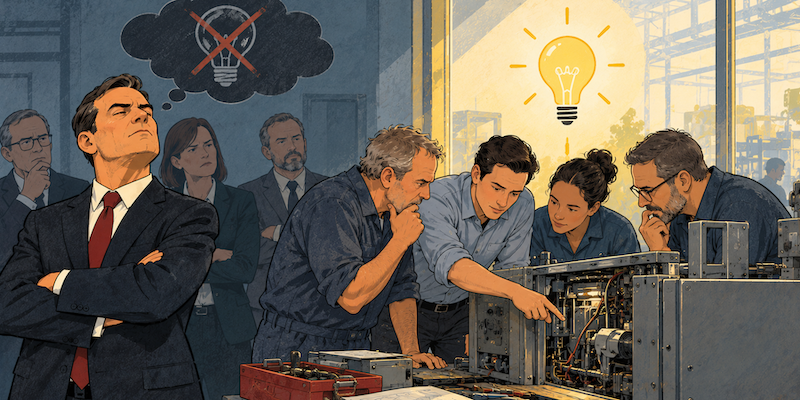
“Lean is just a buzzword people use,” the sales executive declared with dismissive confidence. “It has never worked anywhere.” The CEO leaned forward approvingly. “The only thing that really works is hard work. We can drop this lean nonsense — it’s just what consulting companies use to sell their services.”
Sitting with the rest of the business managers, I was looking at the thing that stops Lean more often than any technical obstacle — though it would take me a while to really understand it: leaders so invested in looking competent that they cannot admit what they do not know.
The same pattern from the top management team was playing out lower down as well. When I suggested a simple root-cause analysis after our testing machine had failed yet again, the production manager’s reaction was swift and defensive.
“Are you questioning my thirty years of experience?” His voice carried a mix of anger and hurt. “I know what’s wrong with this machine. It’s old equipment with electrical issues. We’ve been fixing these problems for years.”
The resistance wasn’t about workload or priorities. It was about professional identity. He did not want to admit he was unsure what a proper root-cause analysis really involved — just as the sales executive and the CEO could not admit they had never really worked with Lean.
What I was slowly starting to see was this: Lean asks leaders to do the one thing their careers have trained them to avoid — to admit, in front of their teams, that they might not know. For most successful leaders, that feels like professional suicide.
The production manager had built his reputation on knowing what to do when things went wrong. His expertise was real. He could make a fast decision in a crisis and keep production moving. But that same expertise had quietly become a wall against looking deeper.
When I pressed for a formal root-cause analysis, I was asking him to acknowledge, in public, that his approach might be incomplete after thirty years of success. That his fixes might be treating symptoms rather than causes. That a careful look might turn up something he had missed.
It takes real courage. Leaders build their careers on having the answer ready. Lean asks them to hold the question open a little longer, and to be visibly curious about what they don’t yet understand.
And then it turned on me. It would be easy to tell this as a story about other people’s blind spots. The harder thing to admit is that I had one of my own. I had walked in certain that root-cause analysis was the answer, and I pushed it much as the production manager pushed his thirty years — too quick to lose patience with anyone who couldn’t yet see it. I was asking the organization to get comfortable with not knowing while being quite certain I already knew. It took me longer than it should have to notice the contradiction, and noticing it changed how I went about the rest.
This isn’t separate from respect for people, one of the pillars of Lean Thinking. It is exactly that. When we admit we don’t have all the answers, we make room for our teams’ knowledge to come forward.
I also came to see it could not be mandated. If not knowing was going to become acceptable, the organization first had to feel safe enough to allow it.
So we made lean education mandatory for all managers and key informal leaders in my own business area, including support functions like HR and Finance. Rather than sending everyone off-site, we kept the learning on the job, tied directly to the problems they were already facing. We framed it as building a common language, not as remedial training — starting with the fundamentals of customer value, waste, and simple root cause analysis. Not because anyone was incompetent, but because improvement needs shared, systematic knowledge.
The change was striking. Once leaders understood what a proper root-cause analysis involved, they stopped seeing it as a threat to their expertise and began to see it as an extension of it. Improvements followed. Equipment downtime fell by twenty percent, and maintenance costs by ten. Even the “old school” production manager, now with structured methods in hand, became an advocate.
But the most telling breakthrough came from that same troubled testing machine. For years, the team had chased its breakdowns — replacing components, adjusting connections, reinstalling software. Each fix held for a while, which only reinforced the belief that we understood the problem.
When we finally ran a proper root-cause analysis (it took just a few days), we found the real culprit: a loose connection on one of the circuit boards. Years of sophisticated troubleshooting had walked past a simple manufacturing defect that a systematic look surfaced almost at once.
The difference was never technical. The team had always had the skill to find a loose connection. What had been missing was the willingness to stop and question what we were all sure we already knew.
And here is the dilemma we so often face. The very capabilities that get people promoted in a traditional organization are often the ones that hold them back in a lean one.
We promote people for their competence and their certainty. Then we ask them to lead improvement, which quietly requires the opposite — curiosity, and the willingness to say, “I don’t know yet.”
The executives in that meeting were not being strong, though it wore the look of strength. They were doing what the system had always rewarded: projecting certainty. Their confidence that Lean could not work was, underneath, a reluctance to stand in front of something they did not yet understand.
Since then, across other companies and industries, I’ve watched the same reflex play out again and again — the certainty that looks like strength, the question no one wants to be the first to ask. Perhaps we have had the order backwards. Instead of starting with the tools and the methods, we might start by helping leaders get comfortable with not knowing. The question was never whether they know enough about Lean; it is whether they are ready to admit what they don’t.
THE AUTHOR

Read more


INTERVIEW – With the Lean Global Connection just two weeks away, we learn more about the lean healthcare content available to attendees.

FEATURE – What are the main problems people encounter when running a project? The author ran a survey with 126 people over two years and presents the results of his research in this article.
CASE STUDY – The story of Norwegian furniture manufacturer Haugstad Møbel that, thanks to Lean Thinking, was able to transform its culture and unlock the potential of sustainable growth.

FEATURE – Embracing lean is like painting: tools are colors, respect for people is the brush, and true change blends both with intention.
Read more

MY AHA MOMENTS – Opening a reflective new series on his lean “aha” moments, the author recalls discovering the power of gemba observation to reveal hidden capacity without investment.

MY AHA MOMENTS – The author looks back on a factory transformation that proved lasting change begins when improvement becomes people’s own idea.

MY AHA MOMENTS – In the second article of his new sieries, the author addresses the hidden cost of multitasking, explaining why focus—and not constant activity—drives real productivity.

FEATURE - Mission creep, silos and a disengaged workforce are some of the negative effects of traditional management. Michael Ballé offers an alternative based on the respect for people principle of lean thinking.