

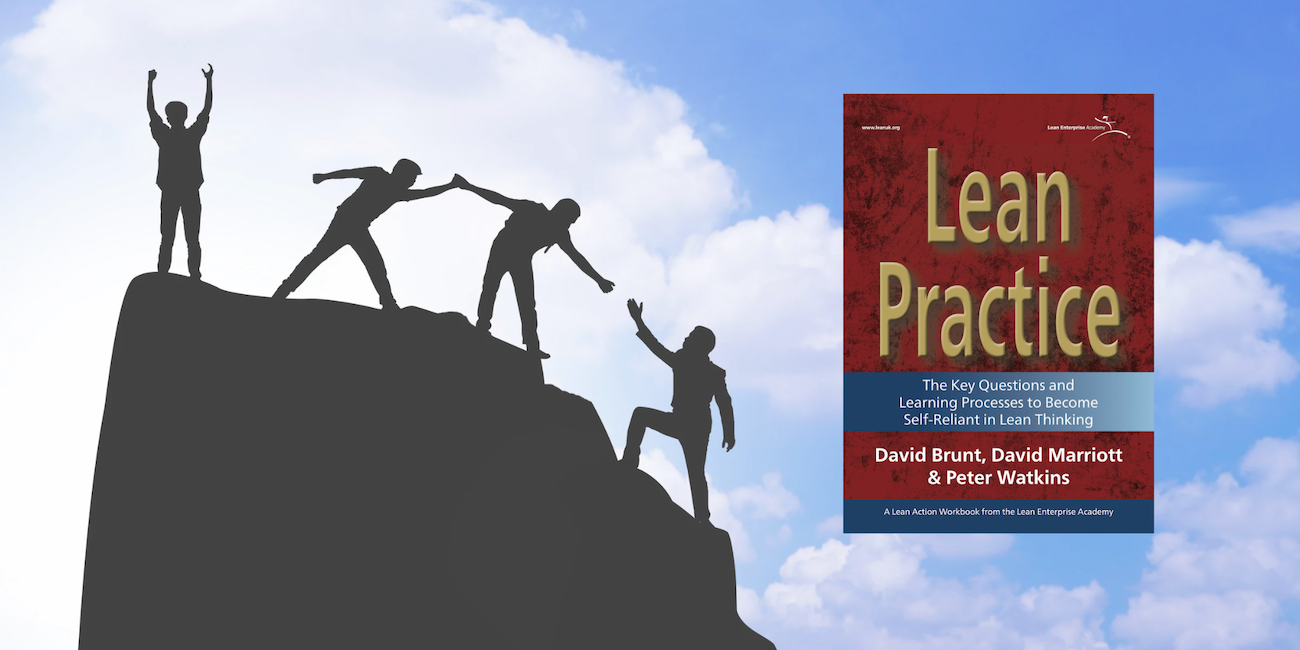
Why do we always start with the tool?
FEATURE - David Brunt explains why lean transformations should start with problems, not tools, and how questions, lean thinking, and deliberate practice help organizations develop lasting improvement capabilities.
Words: David Brunt
Over the past few months, I've had several conversations with organizations looking for help with their lean journey. Interestingly, they all started in much the same way.
"We'd like some help implementing 5S."
"We want to do value stream mapping."
"We'd like to introduce SMED."
The tools changed, but the conversation was always the same. People had already decided what action they wanted to take.
This made me reflect. Perhaps the most common failure mode in Lean isn't choosing the wrong tool; it's starting with the tool in the first place. As one of our mentors, John Shook, frequently reminds us, “If all we have is a hammer, every problem will look like a nail.”
So, before talking about 5S, value stream mapping or SMED, I found myself asking exactly the same question every time:
"What problem are you trying to solve?"
Sometimes there was a clear answer. Quite often there wasn't. And that's important because Lean doesn't begin with action. Good, effective Lean begins with questions.
STARTING AT THE WRONG END
Over the years, we've become very good at talking about lean tools. Courses teach them. Books explain them. Consultants implement them. Organizations often build improvement programs around them. Please, don’t misunderstand, the tools and techniques lean thinkers use to enable value to flow, to build in quality and to develop capabilities in an organization are important. The problem comes when the tool becomes the objective. When that happens, we've confused the means with the end.
We aren't asking, "What problem are we trying to solve?"
We're asking, "Which tool should we implement?"
These are very different conversations.
QUESTIONS COME FIRST
One of the reasons I find the Lean Transformation Framework so helpful is that it starts in a completely different place. It doesn't begin with solutions. It begins with questions.
Those questions help us understand purpose. They help us think about process. They encourage us to develop people. They ask us to reflect on our management system and behaviors. And, perhaps most importantly, they challenge our basic thinking.
Together they establish what good looks like. They become the standard against which we can reflect on our current condition. Questions come first.
QUESTIONS SHAPE LEAN THINKING
The next step is equally important. Questions alone don't tell us what to do. The actions we choose depend on how we think. This is where Lean Thinking and its principles come in. Lean Thinking gives us a different way of seeing organizations. There is a Lean Thinking “point of view,” which encourages us to begin with customer value. To see waste as something that prevents value from flowing. To focus on flow rather than local efficiency. To solve the vital few problems rather than trying to fix everything at once. To build quality into the process instead of inspecting it afterwards. To respect people by involving them in improving their own work. To experiment rather than assume. To share what we learn. That way of thinking naturally leads us towards different actions.
Let’s explore this with a couple of examples.
Suppose the question is: how can we improve delivery performance?
Traditional thinking might lead us to increase stock, chase late orders or ask people to work harder. Lean Thinking encourages us to look at lead-time, flow, batch sizes and interruptions to the movement of value. The actions that follow are completely different because the thinking is different.
Or perhaps the question is: how can we improve quality?
Traditional thinking often leads to more inspection. Lean Thinking asks how quality can be built into the process itself. The result might be standardized work, clear go/no-go conditions, better visual controls or stopping to solve problems when they occur. Again, the action follows the thinking.
THEN COMES LEAN PRACTICE
This is why we chose the title Lean Practice for our newly-released book. Reading about Lean Thinking doesn't develop capability. Neither does attending a course. Capability develops when people repeatedly apply Lean Thinking to real problems.
They observe. They experiment. They reflect. They adjust. They coach. They learn.
Over time, Lean Thinking becomes every-day practice. Practice develops capability.
A DIFFERENT APPROACH
Over the years, organizations have tried many different ways of developing lean capability. Some have introduced competency frameworks and certification systems. Others have developed Belts. Some have invested heavily in expert teams. Others have concentrated on implementing tools through projects. All of these approaches have claimed benefits. But many organizations still struggle to develop the capability of everyone to improve every day.
In our book, we argue a different path is necessary. We begin with the questions in the Lean Transformation Framework. Those questions act as our standard process. Our Teach Poster helps create a shared understanding of those questions and the systemic nature of them across the organization. Once we have knowledge and understanding we can “diagnose” our current situation. Our diagnostic helps identify the capability gaps that are preventing progress.
Once you have a clear gap (or gaps) to close you can “pull” the appropriate learning process, tools, and techniques. Our Learning Platform is a receptacle for these learning processes. There are online, face-to-face or workplace based activities.
And lean practice explains how those learning processes help people develop capability through repeated cycles of observation, experimentation, coaching and reflection. None of these elements stands alone. Together they create a learning system.
LEARNING TOGETHER
There is one final piece. Every organization is carrying out experiments. Every organization is discovering something about developing lean capability. Too often that learning remains inside the organization.
What if we could share it? What if we used the questions in the Lean Transformation Framework as a common language for that learning?
Instead of simply sharing stories, we could share what we've learned about each of the questions. Over time, our collective understanding would improve. The questions would continue to guide us. Lean Thinking would continue to evolve. Our practice would become stronger. And we would all become better practitioners.
QUESTIONS. LEAN THINKING. DIAGNOSIS. ACTION
I've come to believe that this is the simplest way to think about Lean. The Lean Transformation Framework gives us the questions. Lean Thinking shapes the way we answer them. We then diagnose what to do, what experiments to make. Our actions are the expression of that thinking. Then we reflect on the results, learn from our experience, and ask ever better questions.
It's a continuous cycle. But rather than starting from a tool, it should always start with the same question: what problem are we trying to solve? Everything else should follow from there.


THE AUTHOR

Read more

FEATURE – The holidays are a time for reflection. The author shares some her reflections on her experience with lean thinking and the role of leadership in a lean transformation.
NOTES FROM THE GEMBA – This month, the author shares her account of a recent gemba walk at a Tier 2 Toyota supplier, which has achieved impressive results by applying TPS.

EDITOR'S LETTER – If you have missed any of our May articles, we come to the rescue with this monthly round-up of Planet Lean content, to provide you with the highlights and keep you up to date with the latest in lean thinking.

FEATURE – When faced with a crisis, like the current one, it is natural to wonder, “Why bother?”. Yet, this is when we most need a growth mindset and a framework like lean thinking to figure out a way forward.
Read more

FEATURE - Are Toyota’s MIFA and Value Stream Mapping really different? This article explores their shared origins, challenges misconceptions, and explains why effective mapping starts with problems.

FEATURE – The Japanese organizing guru has become very popular in recent years, but what does Lean Thinking tell us about her approach?

INTERVIEW – From hospitals to start-ups, lean principles have been applied far beyond their origins at Toyota. This article discusses how lean can be applied to learning – specifically, how we can apply lean learning to learning lean.

OPINION – How many times, in the early stages of kaizen events, have you thought about giving up? Hang in there. As frustrating as they can be, they will also teach you a lot, says our Danish colleague.