

Turning the flow around
NOTES FROM THE GEMBA – By renewing its focus on value and turning the gemba into a place for learning, Veolia Eau France is improving safety, efficiency, and customer satisfaction. (Part 1 of 2)
Words: Catherine Chabiron
When, in 2021, Pierre Ribaute took over as head of Veolia Eau France, he inherited a company that was struggling to find its footing after two voluntary redundancy plans and a job protection program between 2012 and 2018.
“The company had adapted to changes in its environment through transformation plans, in order to continue offering acceptable prices to customers. We needed a different dynamic, one that was more positive, more flexible, focused on step-by-step improvement, everywhere, all the time.”
Pierre Ribaute, Managing Director of Veolia Eau France
And that is precisely what I am observing today in Avignon, in south-eastern France, the first stop on this journey into the world of Veolia.
I am welcomed by Eric Lahaye, who tells me that the company’s activity in the Mediterranean region (of which he is Director) is threefold: management of public drinking water services (production, distribution, customer relations), management of public sanitation services (wastewater collection, treatment), and worksites. Veolia is the leader in water and sanitation services management in France, and in this region, it operates more than 200 wastewater treatment plants and nearly 300 drinking water production plants.

THE OBEYA: SHARING CHALLENGES AND SOLUTIONS
As we enter the Obeya, we are joined by Olivier Campos, Director of the Provence-Alpes Region. The boards in the room clearly reflect the organization’s most pressing challenges: safety, quality ("right first time"), cash flow, and cost control.
"Our role is to listen to our customers and support their ecological transformation, offering them solutions that are tailored and adaptable to future developments, at the right price. Innovations, such as advanced leak detection technologies, are part of the answer. But we also reduce the maintenance costs of existing infrastructures and improve the efficiency of customer service by getting it right the first time. Satisfying consumers means satisfying the community.”
Pierre Ribaute
Led each month by one of the managers, Olivier's Comex follows a consistent format: reviewing indicators, sharing experiences, monitoring progress initiatives, and working in small groups on improvement projects.

Olivier considers these exchanges essential: "It allows everyone to grow, to take a step back and see the bigger picture. We've moved from a mode where everyone justifies their existence to teams working on common issues. One person's solution may be another person's problem, so it's essential that we share what we're working on."
The issues shared are not ethereal concepts; they go into detail about flows and difficulties, as evidenced by several examples of cause analysis posted on the boards, whether it's a spill of effluent or an administrative flow.
Eric confirms that these rituals are profoundly changing the culture: "Instead of a top-down ritual, there is more sharing, and therefore more learning."
STARTING WITH GEMBA, TO RELEARN HOW TO SEE
Eric was not completely convinced by the gemba concept at first: "As an engineer with 30 years of experience, I thought I knew everything about the job. Or that I could rely on my experts. The gemba forced me to face the reality on the ground, whether at the start of the day or at customer facilities."
Olivier confirms that he now goes to the gemba with a specific intention: safety, stock levels, preparing a roadmap, etc. "The gemba has become a space for mutual learning: I am learning to see and I am striving to develop the group leader I am supporting." Olivier shows them how to question their team members to get them to think ("What is the next step?") rather than imposing a solution on them.
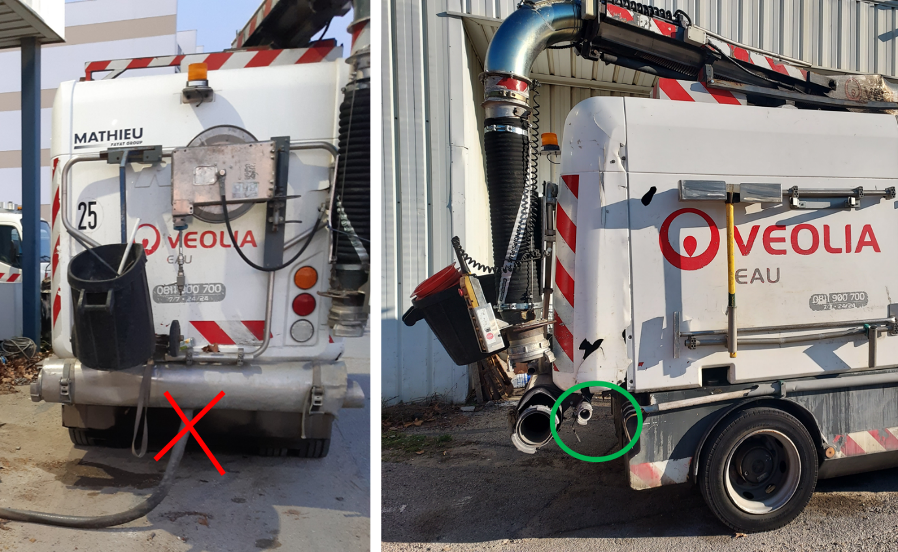
He recounts a gemba walk, during which he observed how an agent had to regularly kneel down to connect a hose to the back of his water suction truck. "Fifty times a day, the agent would stop, kneel down at the back of the truck, and connect his hose. When I returned, I asked the entire team to help him improve the ergonomics of the system. They thought about it, proposed a solution, and the suction connection was moved to a height accessible to the operator on the side with a more flexible hose. In addition to extra comfort and better ergonomics, the new solution saved him one minute per operation— that’s 50 minutes each day."
“My role, I am finding out, is to ensure that the agents succeed,” reflects Olivier.
The trade unions were involved in the process from the outset, via shared gemba walks. Initially sceptical, they recognized the positive effects on the teams' daily lives.
KNOWING HOW TO SEE THROUGH THE EYES OF THE CUSTOMER
Sometimes doing your job well is not enough. One day, a customer gave the company formal notice to clean up the area they had been working in: cable ties on the floor, a missing bonnet, torn cardboard boxes. The team did not understand. Everything in the contract was OK, effluents and waste were good, and the equipment had been maintained or renewed as planned. The client, however, felt differently, starting to doubt the quality of the service.
The team stepped up, assigning each member a sector and embarking on a systematic operation of sorting, tidying, and cleaning. Instead of driving around the area, they now walk it, equipped with a bucket or bin bag. They begin to see what the client sees. They make regular inspection rounds to maintain the new level of tidiness and cleanliness. Anything that cannot be removed or repaired immediately is marked with a "being processed" sticker.
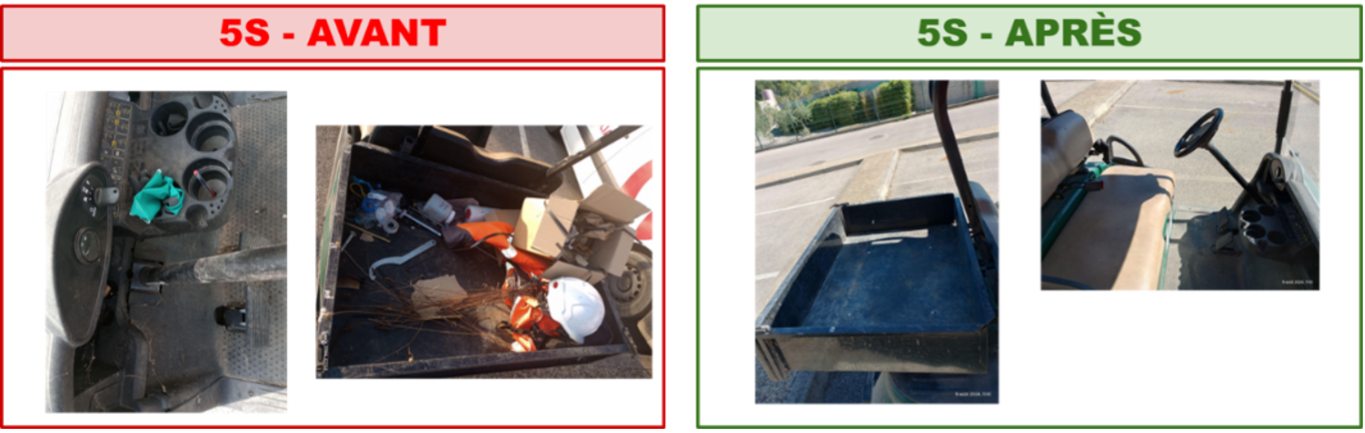
The photos speak for themselves, and the customer is reassured. The contract, which was due to expire, has been renewed for five years.
"It's obvious: there's no 100% guarantee that we'll keep our customers if we do our job well. But we're 100% sure we'll lose them at the first opportunity if we do it badly. So we strive to do our job well in every way, to rediscover the joy of a job well done."
Pierre Ribaute
PREPARING FOR THE DAY
Making the day a success also means giving agents visibility on what they are going to do. "Too often, they would arrive in the morning without knowing what they had to do, without having prepared the work," Olivier explains.
He recounts a very eye-opening gemba walk: "When the agent left, he only knew that he had a valve to replace and that the scaffolding to access it had been installed. But when he arrived on site, he was faced with multiple questions: how to get up and down the scaffolding with a heavy and bulky valve? How to operate the change at height?"
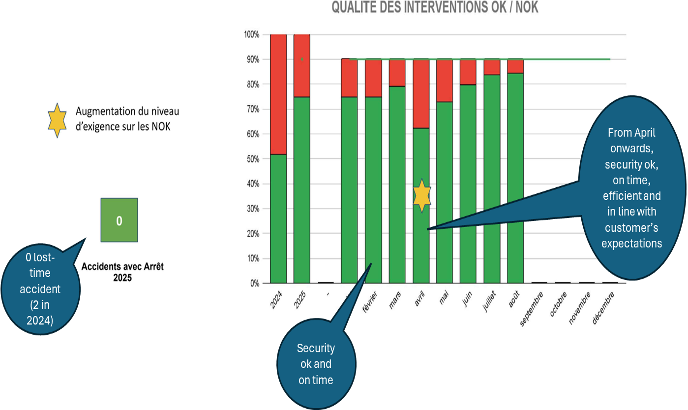
Several very concrete initiatives have emerged on this subject. Jérôme, one of the works managers, worked on site preparation with his teams, structuring their approach using A3 Thinking. With stricter requirements for worksite success introduced in April 2025, the rate of sites getting it right first time is now approaching 90% and safety is improving.
Olivier smiles. "There are no easy worksites, only well-prepared ones," he says. In the morning, each team holds a debriefing on the previous day and a briefing on the day ahead. This ritual provides a useful framework for managers who are sometimes new to their roles.
We go to see Aurélie, one of these managers. She confirms that these briefings and debriefings have improved the profitability of worksites by 10 to 15%. "Debriefing on the previous day encourages people to flag up problems, such as a chainsaw that was malfunctioning. A dojo with the supplier helped us to better understand how the tool works and its limitations, and to eliminate the difficulties."
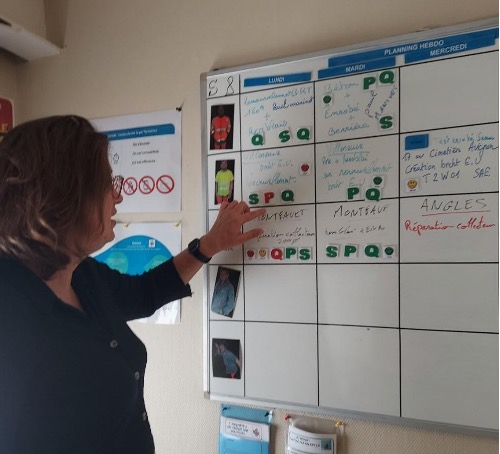
Aurélie also lets technicians voice out their emotions, such as “the day was a mess” during the debrief. “When are angry or discouraged, you lose 30% of your energy,” she says. She remembers a repair job, where the technician dug, spent time looking for a leak, only to discover that everything was okay. These daily rituals are short, so that everyone can leave with more energy.
The teams have also worked on preparing "site kits," which we are about to see outside. Previously, agents would queue up every morning at the warehouse to collect the equipment they needed for the day. Now, needs and risks are anticipated on Mondays, and the boxes corresponding to the following week's needs are prepared on Fridays, so workers can go straight to work. The time saved is estimated at 45 minutes per day per worker.
Farid, the group leader we meet on site, adds: "This preparation system also avoids unnecessary trips back and forth. Discovering that you have the wrong part in Roquemaure means you are going to waste an hour."
Conducting on-site reconnaissance, identifying the necessary tools and parts, measuring the right first time and the actual profitability in terms of time spent, this preparation has become a real learning tool and gives meaning to the agents' work.
“I regularly do gemba fieldwork in the service technicians' trucks, during operations in plants or I attend morning briefings. One day, I asked a technician in this Avignon area: What does lean bring you? And the technician replied: I sleep better at night.”
Pierre Ribaute
REDUCING COSTS
This careful preparation work also applies to administrative processes. Poorly prepared work documentation, or invoices sent to the local authority that must be redone are examples of wasted time for the customer. Jonathan and Denis, whom we are now visiting, have tackled the problem by taking a close look at the specific characteristics, expectations and constraints of each local authority. Information gathering begins as soon as the site opens: in just a few months, with the help of the managers concerned, they have improved the compliance of preparation files from 20% to 90%.
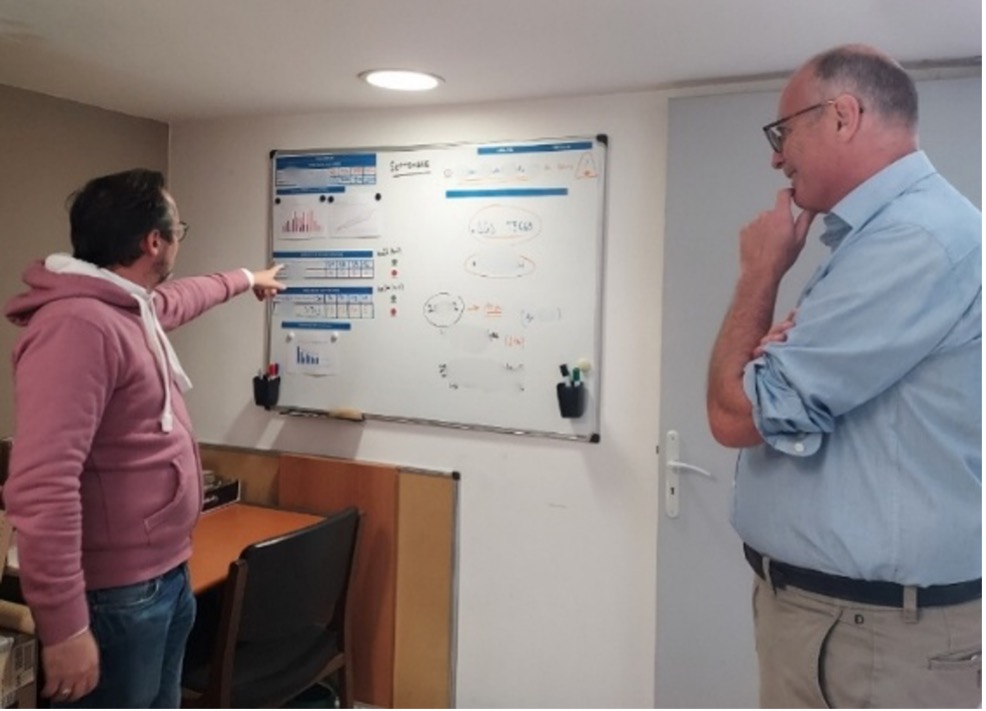
Eric looks with interest at the bi-monthly animation chart that Jonathan shows him and challenges him: "Great job, but how can you be sure that you've identified the root causes of the latest incident you describe?"
We continue our gemba walk in the warehouse, where stocks of flanged parts, pipes and other materials are very cash intensive. Olivier and Eric quickly spot an interesting improvement: flanged parts dating from the last drinking water contract are no longer needed, as this part of the Avignon contract was lost to a competitor. They can be made available to another region, thus avoiding the need to purchase new ones. They will also free up space on the ground floor of the warehouse (they are too heavy to be stored upstairs) and Yann, the warehouse manager, will have the parts most frequently used by the teams at his fingertips. This frees up cash and square metres, while reducing handling.
CONVINCING RESULTS
The measurable effects of these improvements are significant, as Alexandra, the region's lean officer, shows me. The rate of accidents resulting in lost time fell by 50% at the end of August in all territories within the region that have committed to Lean. Additionally, €1.3 million in cash has been freed up and operating expenses have been reduced.
"Over the past five years, we have initiated a genuine commercial dynamic focused on listening to and satisfying customers at all levels of the organization. The results are very encouraging: our NPS has doubled over this period, and our customers are renewing their trust in us every year, with an increasingly positive commercial balance sheet."
Pierre Ribaute
Eric concludes with a smile: "I've been with the company for thirty years. It’s fair to say that I know the business inside out. Yet, I've learned more in these last three years, since we have embraced Lean, than in the previous twenty-five."
This sums up the cultural transformation taking place at Veolia Eau France: be wary of what you think you know, go and see for yourself (genchi genbutsu), question, listen, and everywhere, all the time, ask the question, "What's the next step?" This will encourage everyone to think.

Read more

ARTICLE - Improving healthcare architecture means truly meeting patient requirements. This article reflects on the power of 3P design and looks at an implementation in the North East of England.

ROUND-UP – Looking back at the year that just ended, our editor Roberto Priolo reflects on the power and reach of lean thinking, and offers us a round-up of the best content from 2017.
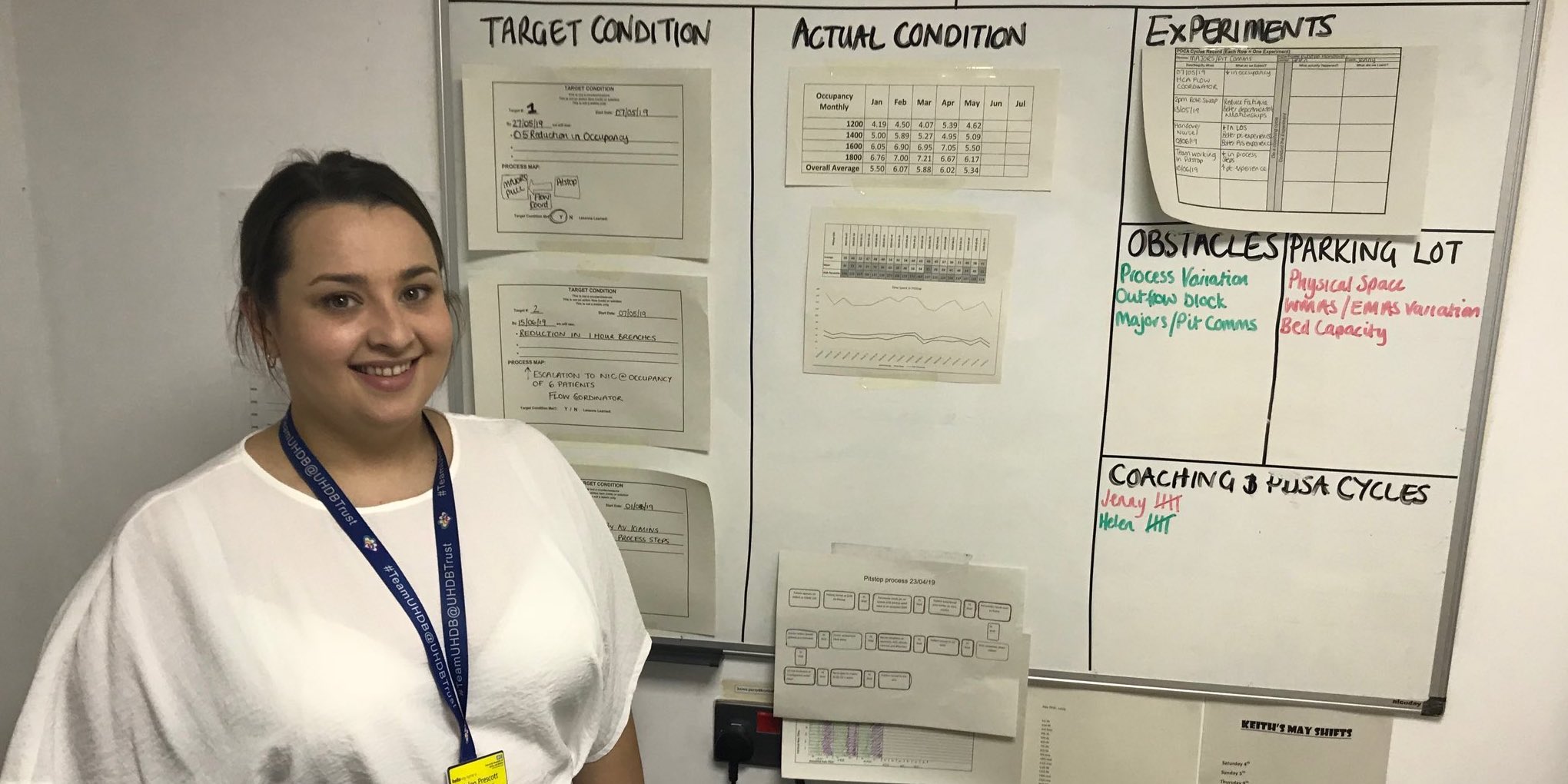
CASE STUDY – Starting with a series of pilot sites, the NHS is hoping to engage the Kata coaching approach to really spread an improvement culture to staff and patients.

INTERVIEW – A private healthcare group in South Africa has carefully studied the unique challenges it faces and customized its approach to improvement accordingly, embarking on a lean journey to better patient care.
Read more
NOTES FROM THE GEMBA – This article explores how Sodebo’s leaders use TPS to scale craftsmanship, improve flow, and strengthen consumer focus across operations.
NOTES FROM THE GEMBA - Alliance MIM navigates market crises leveraging Lean Thinking, emphasizing flow, maintenance, deep process knowledge, and visible learning to stay competitive in a complex, high-precision manufacturing environment.
CASE STUDY – Lean Thinking helped Bernard Controls Europe improve efficiency, reduce lead times, and enhance quality, fostering resilience in the post-pandemic industrial landscape.
NOTES FROM THE GEMBA — This French tech firm thrives through Lean Thinking, continuous learning, and customer-focused innovation, embodying Toyota-inspired resilience in software development.