

Strengthening maintenance quality through Lean Thinking
FEATURE - Lean discipline strengthened maintenance quality at Vale Indonesia’s nickel smelter by developing leadership, enabling early detection, and improving furnace reliability.
Words: Yaman Parid and Kemal Aswin
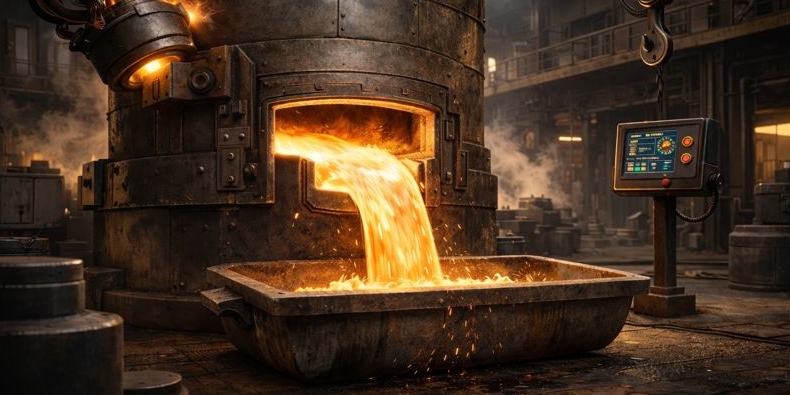
At Vale Indonesia’s nickel smelter, the furnace is the key production process. Think of it as a giant, extremely hot machine that melts materials to extract nickel.
For the furnace to work properly, four supporting systems must all work well:
- Electrode slipping system: the electrodes are huge carbon “rods” that deliver electricity into the furnace. As they slowly burn away, this system feeds more electrode down so the power keeps flowing.
- Electrode hoisting system: this system raises or lowers the electrodes to keep the right distance from the molten material. Too high or too low, and efficiency or safety drops.
- Calcine feeding system: calcine is the prepared nickel ore. This system feeds the raw material into the furnace at the right rate, like adding ingredients while cooking.
- Slag launder tilting system: slag is the waste material that floats on top of the molten metal. This system tilts channels (launders) to safely drain slag out of the furnace so production can continue.
If even one of these systems fails, the whole process suffers— with disrupted operations flow, compromised safety, and significant production losses.
In early 2025, despite having maintenance plans and preventive maintenance routines in place, the furnace reliability remained below expectations. Recurring breakdowns led to 28 hours of lost production within the first 24 weeks of operations, forcing us to scramble to fix problems.
To break this cycle of reactive maintenance, we turned to Lean Thinking.
Our main challenge was the reliability of furnace components essential to smelting operations stability. While each system had its own preventive and predictive maintenance strategy, the execution of the strategy often failed to detect early abnormalities.
This gap between expected and actual performance resulted in frequent equipment failures, especially in the electrode slipping, calcine feeding, and slag launder tilting systems. It reflected a deeper issue in the quality of maintenance execution.
We set out to strengthen the maintenance quality by building a work process able to detect equipment abnormality earlier and correct them before they become bigger problems, while minimizing breakdowns of the critical systems in the furnace.
The improvement team reviewed the Maintenance Work Management Cycle, which is designed to ensure problems are caught early, work is planned, scheduled, and executed with discipline, and learning occurs after each intervention.
The review taught the team an important lesson: most breakdowns resulted from the way the preventive maintenance (PM) program was executed in the field. The program was mostly complete, but it wasn’t performed thoroughly and to high quality. Several abnormalities went undetected and then grew bigger, eventually causing breakdowns.
To close this gap, the improvement team focused on addressing two things:
- Strengthening preventive maintenance execution quality. Detailed checkpoints were added to every preventive maintenance task list. Supervisors must now check whether the PM execution meets the required quality standards, not just whether the work has been completed. This means they need to verify that the technicians have accurately identified any abnormalities that occurred.
- Clarifying roles and responsibilities for PM process. Managers assumed the responsibility of overseeing the quality of the entire PM process, while supervisors focus on quality checks and coaching and technicians ensure the accuracy of inspections, with abnormalities identified and issues swiftly escalated.
Both areas of focus aimed at improving the effectiveness of the existing PM work process, not necessarily adding new maintenance tasks. This ensures that PM would become a powerful mechanism for preventing failures rather than reacting to them.
DEVELOPING PEOPLE’S SKILLS
The team then conducted a study of the supervisor’s daily work. This revealed that 61% of their daily work was incidental, driven by unplanned failures rather than planned preventive tasks. This signaled the need to strengthen supervisor capability, their routine management, and technical judgment across the leaders.
In response to this, we introduced Standardized Routine Management to define and develop leader capability through structured routine activity:
- Manager routines: Daily reviews focused on key indicators such as PM compliance, MTBF, MTTR, and safety measures. Manager monitors the performance trend to identify where coaching or support is needed for his team.
- Supervisor routines: Supervisors assign daily maintenance tasks, verify PM execution quality, review abnormalities, and facilitate short problem-solving discussions with his technicians.
- Routine gemba and field coaching: Manager and supervisors jointly observe PM execution at the gemba. They validate inspection findings, reinforce standards, and build technician capability through practical coaching.
As this new, clearer organization of the work took hold, learning became part of the daily routine. Each day provided an opportunity to strengthen the team’s ability to detect abnormalities earlier and prevent breakdowns from occurring.
WHAT ABOUT LEADERSHIP?
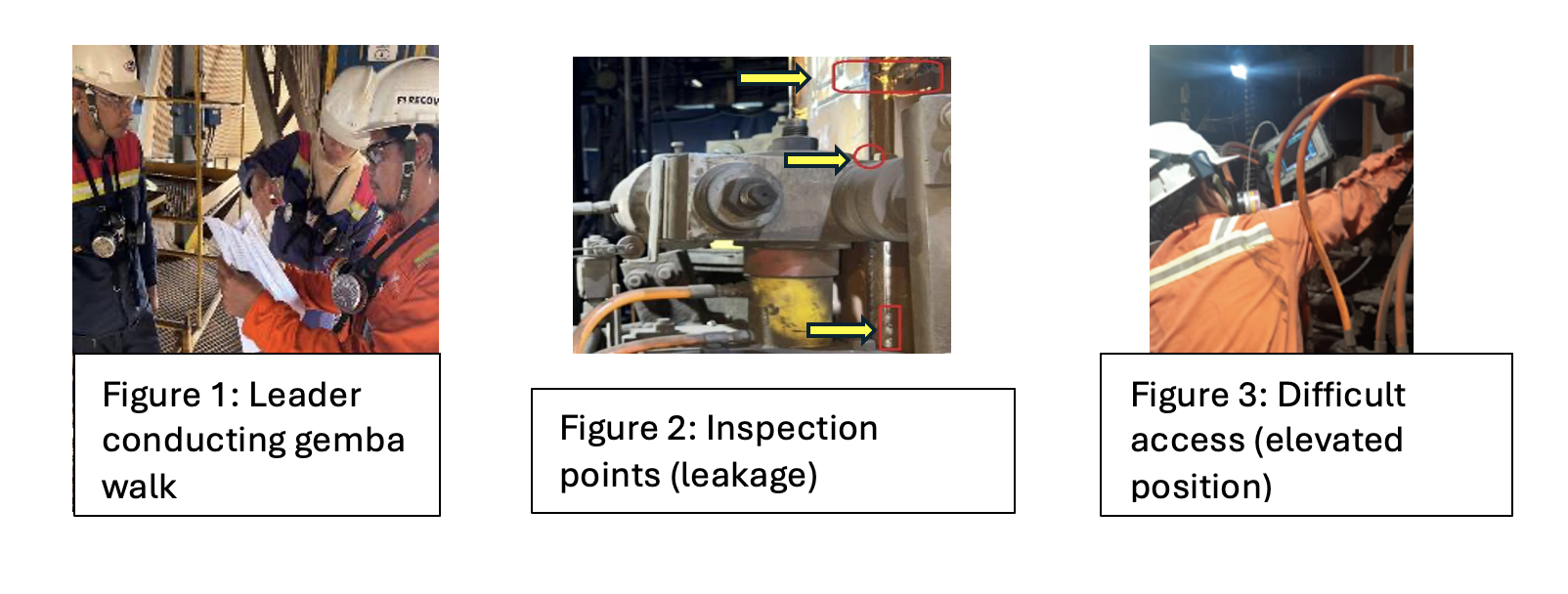
To sustain these improvements, we also established key lean leadership behaviors: go and see (maintenance leaders regularly conduct gemba walks to observe the actual condition of equipment and how maintenance work is executed), ask why (they encourage inquiry, reflection, and problem-solving instead of providing quick answers, while helps technicians to understand root causes and sharpen their judgment), and show respect (by removing obstacles, following up on issues, and supporting technicians in solving problems, leaders show respect for their team. This also helps create an environment where problems are flagged up, rather than hidden).
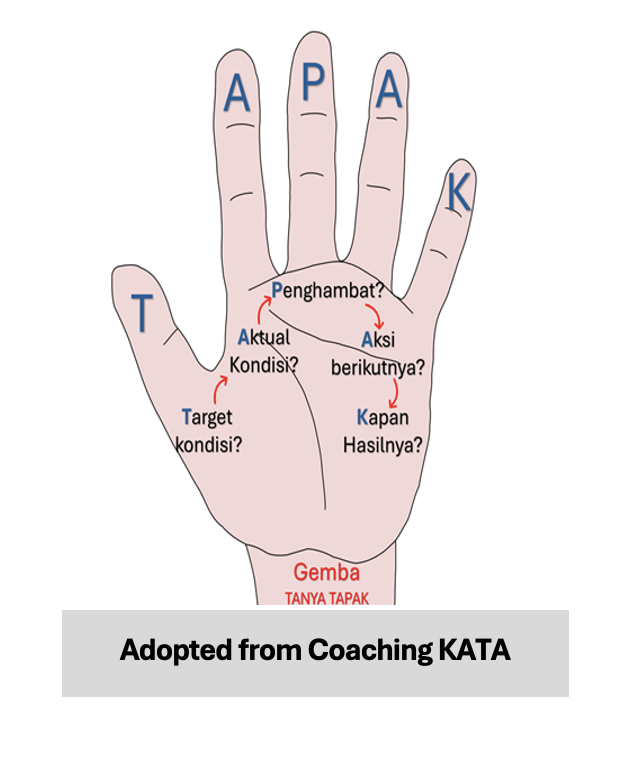
To practice these behaviors, the leaders are using the TAPAK method—a practical adaptation of Kata Coaching for daily leadership behavior. In Indonesian, TAPAK means “handprint.” It stands for Target kondisi (Target Condition), Aktual kondisi (Actual Condition), Penghambat (Problem), Aksi (Next Action), and Kapan (When). It reminds leaders to go to the gemba and leave a positive mark (handprint) through five simple coaching questions.
With TAPAK, gemba walks shifted from inspection to learning, and leadership went from giving instructions to developing people’s thinking. During their gemba walks, leaders don’t judge, asking questions, listening, and learning instead.
Here’s an example of a conversation taking place during a typical TAPAK gemba walk.
- Target condition: What’s your target today? The technician explained that his goal was to complete the PM task and ensure the system operated without leaks.
- Actual condition: What did you find? A leaking and malfunctioning seal.
- Problem: What makes this difficult? Access, it turned out, was difficult and unsafe due to elevated position.
- Action: What’s your plan to overcome this? The technician proposed building a small ladder or platform to improve safety and ease future checks.
- Kapan (When): When will we see the result? The technician committed to engaging a small team to realize the idea and review the improvement after a few weeks.
Through this short dialogue, the leader supported problem solving without providing answers. This way, ownership stayed with the team and learning happened in real time.
This is coaching leadership in action—simple, respectful, and focused on developing capability. The TAPAK approach transforms daily walks into learning routines, where every problem becomes an opportunity to strengthen thinking and sustain improvement.
A SHIFT IN OUR WAY OF THINKING
As routine management strengthened and leaders became more engaged, the team realized that the root cause of problems extended beyond technical work. It involved the team’s underlying assumptions about maintenance work execution. Initially, many believed that leaders’ routines did not significantly influence equipment reliability: preventive maintenance was seen as a checklist activity rather than a learning opportunity.
Through the disciplined application of daily coaching at the gemba, however, the team’s thinking began to shift. Now there is an understanding that maintenance quality increases when leaders build capabilities, strengthen routines, and support learning every day.
The results we observed validate this new way of thinking: astonishingly, breakdown losses from the four critical system mechanisms were reduced from 28 hours (week 1 – 24) to just 1.2 hours (week 25 – 49). Additionally, the maintenance team became more proactive and learning oriented.
Our experience shows that reliability is not the outcome of more tools, but of daily discipline supported by strong leadership and clear standards. It also confirms that Lean Thinking can strengthen technical execution and create stable and predictable operations.
By focusing on the quality of execution, developing people, and reinforcing learning every day, our team built a system that ensures long-term reliability, with daily discipline becoming the backbone of our maintenance culture.
THE AUTHORS
Read more


ARTICLE - To operate successfully we need systems, but as we grow these often give us "big company disease." The solution is bringing leadership at work level to really guarantee customer satisfaction.

LEAN THINKING WOMEN – We speak with women lean leaders about the link between gender equity and the creation of value as well as the value of diversity to the global lean community.

OPINION – Tomorrow, January 20, Donald J. Trump will be sworn in as 45th President of the United States. What can his campaign and dumbfounding victory teach us about leadership?

FEATURE — Lean Thinking is redefining agriculture by turning farms into systems of continuous learning, boosting productivity, reducing waste, and empowering people through daily problem solving.
Read more
CASE STUDY – This nickel smelting operation in Indonesia used the Lean Transformation Framework to optimize furnace inspections and minimize delays.
CASE STUDY – This Indonesian nickel smelter used Lean to stabilize furnace operations by reducing excess carbon in calcine through root-cause problem solving, automation, and operator-driven improvements at the gemba.

INTERVIEW — Ahead of next week’s Lean Global Connection, one of our speakers talks about how the comprehensive lean transformation of Indonesian food company Garudafood.
CASE STUDY – This 104-year-old Chilean provider of integral solutions for the mining industry has turned to hoshin kanri to effectively connect everyone’s work with the overall business strategy.