

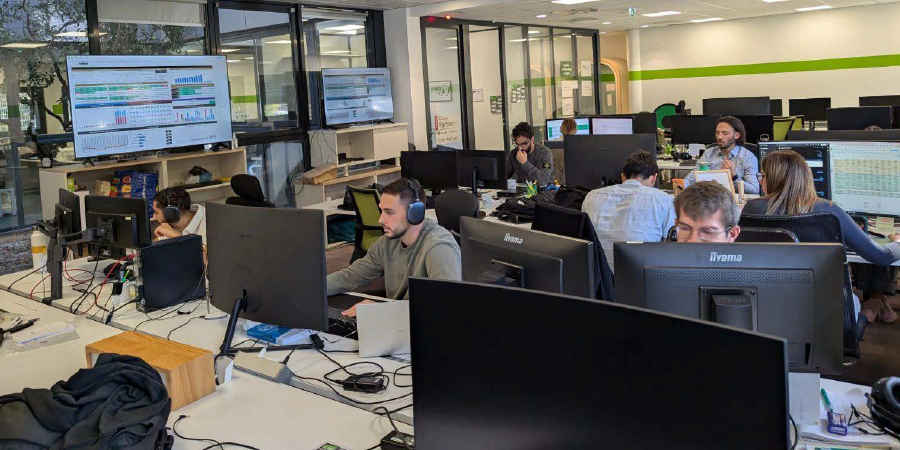
JVWEB: eight years on, Lean sells
NOTES FROM THE GEMBA - Back at web agency JVWEB eight years on, Catherine finds production plans, team leaders and quality checks helping consultants deliver reliably and win business.
Words: Catherine Chabiron
Ten years ago, Jonathan Vidor was on the verge of selling the web marketing agency he had founded in 2004. Problems were piling up at JVWEB, keeping him up at night. He decided to persevere and, by 2018, he had been to Japan twice, visiting Toyota and some of its suppliers, while Lean had made its way into JVWEB’s open-plan offices, where production schedules, team leaders, and kaizen began to appear. I have told that story here.
Fast forward to today, Jonathan is still there, the number of consultants has doubled since 2016, and revenue per consultant has increased by 80%.
How does lean help you increase sales per head in such proportion? The short answer, as I discovered, is that JVWEB's lean system is what allows it to sell. Reliable delivery keeps clients, coached consultants turn review meetings into new business, and well-controlled costs open up a market competitors find hard to serve profitably: more than half of JVWEB's revenue now comes from small and micro-businesses. To see how this works, I tagged along on one of the visits organized by Institut Lean France for the local lean community.
SELLING A HIGHLY TECHNICAL SERVICE
JVWEB doesn’t sell a product, but rather an optimization service. Nicolas Sady, head of operations, explains SEA (Search Engine Advertising) to us: “When you perform a search on the Internet, ads related to your search appear at the top of search engine results pages because advertisers have paid to have their products featured there: carefully chosen keywords increase their visibility and boost their chances of making a sale; they pay on a cost-per-click basis. A consultant at our firm typically manages between 3 and 8 different client accounts, so they handle an average of 200,000 keywords and 12,000 ads.”

Given the sheer volume of data to manage, the risk of making a mistake is significant. In France, for instance, the word “sale” (soldes) may only appear in an ad during the official sales periods set by law. Leaving it in an ad after the period ends, or letting a spelling error slip through, could lead a client to cancel the contract. Prolonged underperformance in the face of the allocated budgets will likely tempt them to look elsewhere or stop spending. In this business, the product the client sees is reliability, and a single visible error can cost the account.
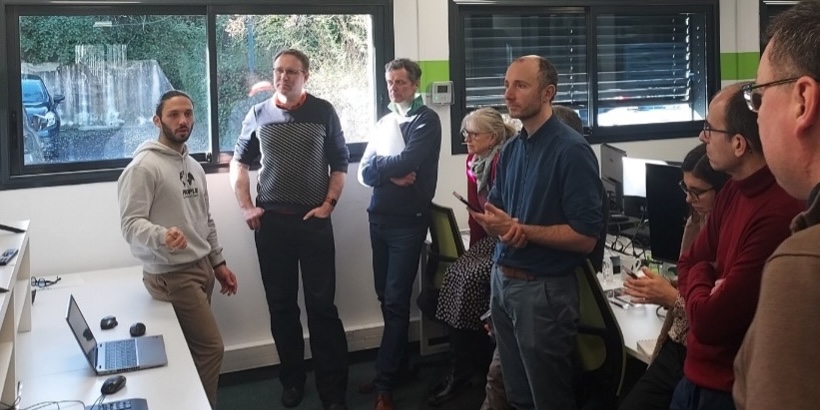
Matthieu, one of the SEA team leaders whom Nicolas introduces us to, helps us better understand the service the company provides: “Optimization is an ongoing process — landing pages change, a client’s competitor makes a move, a seasonal promotion begins. We must constantly carry out a wide range of activities — optimization, monitoring, reporting, listening, and needs assessments — with each of our clients.”
A PRODUCTION PLAN TO LEVEL THE EFFORT AND DELIVER ON TIME
The high volume of tasks has led JVWEB to create a production plan.
In 2018, during my first visit, I had seen a very early version of it, listing only the day’s tasks. At the time, the team was still figuring out the sequence of tasks and lacked the experience to set standard times. Some used lists in notebooks; others sticky notes.
What Matthieu shows us during my visit earlier this year is completely different. The systematization of the process has clearly made it possible to structure and organize more activities than in 2018. Today, a consultant has 30 to 50 tasks to manage per client, all of which must be scheduled. Without this production plan system, they can very quickly find themselves overwhelmed.
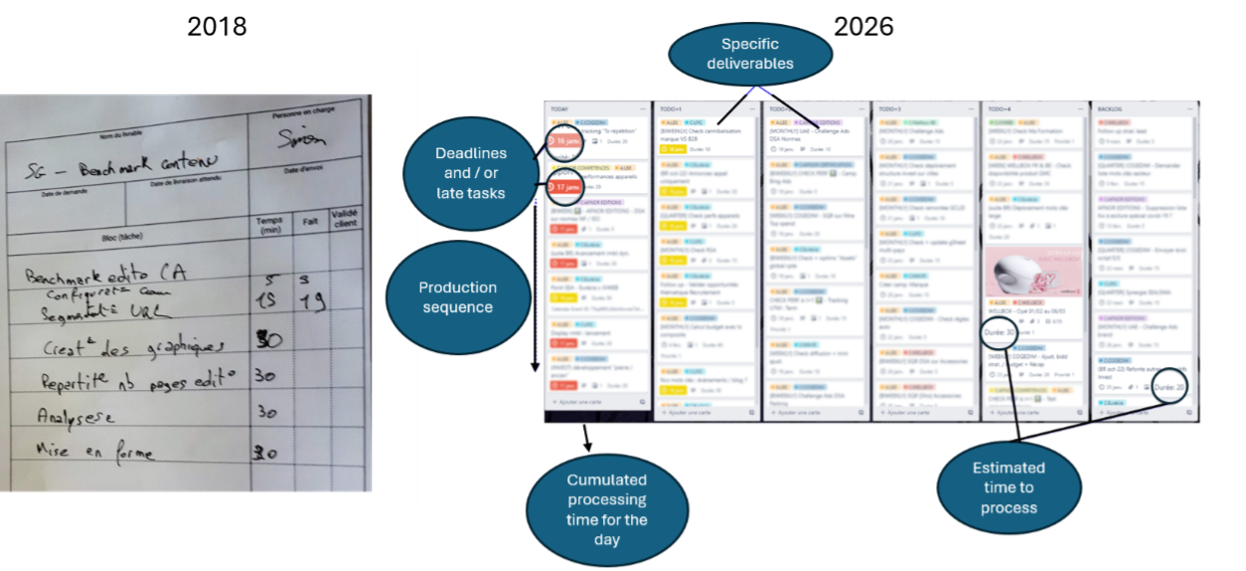
The production plan is now created using a highly customized, internally developed task management software. Each task is represented by a kanban card, with a specific deliverable. This helps team members understand the parts and products they are manufacturing: the kanban card specifies the action to be taken and its checkpoints.
“It has changed the nature of our gemba sessions. Instead of discussing generalities like ‘How’s your client doing? Is performance good?’, we look at a specific part and learn together.” - Jonathan Vidor
Each kanban has a start date and an allocated time, ranging from five to thirty minutes —sometimes an hour — to respond to a prospective client’s request for proposal (RFP) or prepare for a business review. The system calculates the estimated daily work time by totalling the time on the cards. Matthieu shows us how this helps highlight potential delays every time the consultant marks one as “completed.”
Each consultant creates their work plan for the day, as well as for the days ahead. A client task, a kaizen, or a routine check can be created and scheduled on a just-in-time basis to spread out the workload and reduce mental load. The team’s visual management board displays the future work already scheduled and how the workload is distributed over time.
“To organize the day effectively, the order of tasks is very important,” says Matthieu. “I recommend that they start with the tasks that are important to the client — which, incidentally, are usually the ones that require the most mental effort. If they can’t complete all the tasks for the day, the ones that fall behind will be the easiest or less important ones.”
Matthieu reviews the production plan with each of the junior consultants every morning. If a task he knows he can complete in five minutes is scheduled to take thirty, that’s an opportunity to ask questions and provide hands-on training. The team leader no longer needs to wait until the end of the day to discover undelivered or delayed kanbans; Matthieu can step in to help as soon as he sees one.
Nicolas adds: “It would be a mistake to stop discussing the production plan with the consultants just because they’ve become self-sufficient. Our team leaders continue to discuss it regularly with each member of the unit. It’s a great opportunity to talk about clients, ongoing improvements, and spot creative ideas.”
As head of operations, Nicolas is the driving force behind this standardized production plan, which he conceived when he was himself a young intern: the peace of mind and control it gave him quickly convinced his then team leader, Colin, who helped him refine it and served as a key advocate for the widespread adoption of the approach.
“Nicolas has revolutionized the way we work in his unit. It’s so much simpler than what we had before — all customer requests are in one place, the mental load is reduced, and we don’t forget anything. The best ideas come from the people doing the work, at the front line.” - Jonathan Vidor
For the client, this is what on time looks like: nothing forgotten, and every request in one place.
DELIVERING QUALITY: THE KEY ROLE OF THE TEAM LEADER
This systematization of task management and the help chain that begins with the team leader have clearly enabled consultants to generate significantly more revenue. At Toyota, a seasoned team leader supports only five to eight front-line operators, whereas most companies give a single supervisor 15 to 20 people, with no team leader in between. JVWEB can confirm the underlying assumption: this additional position isn’t an extra cost, but an investment in quality, speed, and continuous improvement.
Team leaders are, in fact, the first link in the help chain, helping resolve problems at the workstation and drive improvement within the cell. At JVWEB, the ten team leaders in Montpellier lead cells averaging four people each.
“This is the best decision the company has ever made! Team leaders spend 50% of their time working with clients to stay on top of best practices and keep up with the e-commerce and search engine markets, where rules can change very quickly. And they’re available the rest of the day to provide training and make life easier for their team. It’s been a real gamechanger, enabling us to grow and deliver high-quality work.” - Jonathan Vidor
It is also what allows a consultant with less than two years' experience to sit across the table from a client's CEO.
IN-HOUSE SKILL DEVELOPMENT TO DELIVER BETTER AND MORE
“JVWEB made another successful bet,” explains HR Director Tiffany Guilpain, who is accompanying us on the gemba. “Once we realized the power of this team leader-driven approach, we leveraged it in our hiring process. Our guiding principle is to have a consultant available to the client at the right time and with the right skills. We’re based in Montpellier, in the south of France, and recruiting someone with three to five years of experience in this type of expert role is very difficult. We tried bringing people in from other regions, but they’d leave sooner or later. We consequently changed our strategy: we recruit young people from our region who are fresh out of school, and we train them. A young recruit with two years of experience and training here now provides a higher-quality service than a senior with ten years of experience who’s reluctant to adopt lean practices.”
Matthieu’s team is young, as he confirms: “They’ve been with us between seven and eighteen months. I’ve been a team leader myself for a year. The newest hire is still in his two-month boot camp [onboarding training]; I spend about three hours a day with him.”
Whether it’s recruitment or training, JVWEB has developed a whole suite of exercises to identify potential and hone its young talent. Before taking on a project for their first client, they must demonstrate that they can complete the exercises multiple times without error. It’s a very carefully designed training approach, with one exercise per task.
LEARNING TO LISTEN TO CLIENTS… TO SELL BETTER
Matthieu also shows us how he helps these young recruits prepare for client feedback sessions — a key moment in the client relationship to review what’s been done and the results achieved. The consultant will be able to listen to the client, encourage them to speak up to identify new opportunities, propose improvements, and suggest expanding the scope of work (and thus increase revenue). However, the average age of JVWEB employees is twenty-seven, and the clients they interact with could be anyone from a traffic manager or marketing director to a CEO. The questions to ask during feedback sessions are therefore prepared very carefully with the team leaders. Jonathan himself regularly comes in to help the team leaders with client questioning, to develop their business acumen beyond the technical aspects and the tools.
Through the magic of automation, when a customer’s rating is 8 or lower (on a scale of 1 to 10), the date for the next customer feedback session is automatically moved up in the production plan, and a kanban is created. A PDCA cycle is initiated to resolve the issue.
A FLEXIBLE SOLUTION FOR BALANCING WORKLOAD AND CAPACITY
A consultant, no matter how well-trained and organized, may still experience an unexpected surge in workload if, for example, their client realizes that a competitor is launching a campaign and needs to respond quickly. Lean teaches us never to staff a team based on potential workload spikes, but rather on a recurring workload level. A solution must be found either to eliminate the spikes (not easy in this case) or to assign “rapid-response” resources to them — a very typical but essential process of workload-capacity adjustment.
“It was while visiting a Toyota Material Handling plant in France that we came up with the idea: a back-office team capable of fulfilling tasks for the front-office cells. A tech facility that works equally for all the agency’s clients, on recurring parts they’ve mastered perfectly.” - Jonathan Vidor
Nicolas explains the value of the tech cell by giving us a tour: “It’s a major competitive advantage that offers much greater flexibility and quality. Before, we used to handle workload spikes with one or two interns, but that came at the expense of quality. Furthermore, some consultants enjoy working on performance optimization at the beginning, during the learning phase. But as they develop their client relationships and come to understand their clients’ businesses, analyzing numbers can be less appealing. The tech team, on the other hand, develops real expertise in numbers, IT tools, AI, and web marketing tools.”
Pierre, the team leader, welcomes us to his tech unit, where we discover a true pull system: the production plan here is a task launcher shared by all unit members, displayed by the same task management software. A model kanban card — itself based on the quality standard for the task at hand — is filled out by a consultant and becomes a production kanban for the tech team, which is added to the others on the task launcher, with a sequence determined by the required completion date, thus operating on a pull basis. Pierre checks the production plan every morning and, if necessary, steps in to assign certain cards due to a specific skill requirement. If he does not assign them, the remaining kanbans will be handled by the techs in the sequence order.
CONNECTED CELLS ELIMINATE NON-VALUE-ADDED WORK DAILY
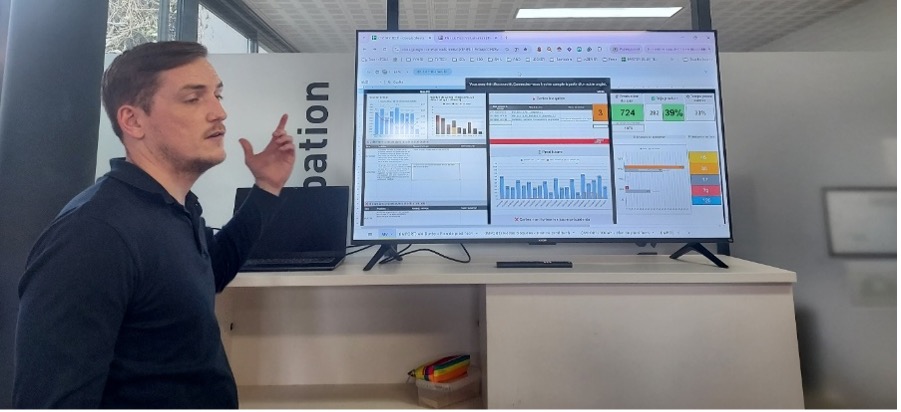
Pierre shows us blocked cards (red bin) on the screen: “Just six months ago, their job wasn’t easy — there was a lot of friction between the consulting teams, who saw themselves as sole decision makers, and the tech team.”
Nicolas, who oversees both the tech team and the consulting teams, helped them with problem-solving. He smiles: “They’ve halved the number of defects, even though the volume has nearly doubled.”
Pierre gives us the example of a report scheduled for February 2 for a client [my visit took place at the beginning of the year], but for which the data won’t be available until February 4. The task is marked as failed; it’s in the red bin. “We’re currently trying to schedule the task on a pull basis relative to the date of the call with the client. If the call is scheduled for the 8th on the consultant’s calendar, the reporting kanban will then be automatically scheduled for the 6th, which leaves two days to review it and prepare for the call,” Pierre explains.
He also shows us the self-inspection list associated with each kanban: a task is only considered complete once the tech in charge has reviewed and approved every item on the checklist. As a safety measure, a “sweeper truck” tool compiles a daily list of errors that slipped past the teams’ attention: the entire system operates based on client, Google, or Meta advertising rules, and these rules change regularly. The tool runs daily to perform automated tests for each client. Nicolas puts the scale of the problem into perspective: “A rule change can, for example, impact 105 different campaigns. Rules in violation that are classified as urgent automatically create a kanban card. If the card isn’t closed within three hours, an alert appears. Personally, I review urgent errors every day at noon and follow up with the relevant team leaders.” Each error caught here is one the client never sees, and one fewer reason to look for another agency.
Defects can stem from technical issues or an incomplete brief from the consultant. If a defect is identified, a kanban card for the problem to be resolved is placed in the launcher, and the person responsible for the defect analyzes the issue with their team leader using a PDCA cycle. If the problem recurs, the two Consultant and Tech team leaders work together to eliminate it. A “Weak Point Management” spreadsheet breaks down and tallies the types of defects found in products, as well as where they originated. The goal is to detect failures in self-inspection, understand them, and encourage teams to implement the PDCA cycle.
Another way to eliminate defects or low value-added activities is the suggestion system.
“The Suggestion of the Month sparks a sense of competition: ‘My idea becomes standard practice — the whole company is trained on it and saves time by using it.’ We hold one such session every month; every suggestion counts, and I present them all.” - Jonathan Vidor
LOOK AHEAD AND GET READY WITH PLANS PER PERSON
How do you prepare for the future when the average age at the company is twenty-seven?
Tiffany and Nicolas offer an initial insight by discussing people reviews. In line with their scientific approach to training and the development plan they provide to new hires, they spend thirty minutes each month with every team leader to discuss the morale, performance, and potential of their team members. This helps plan career progression and identify ways to support those who are facing challenges — a plan for every person. “For me, someone leaving after a year and a half is a red flag,” says Tiffany. “If that happens, it’s clear we have made a mistake in the hiring process. I monitor this red flag very closely because of our investment in training.”
Aymerik Bouchacourt, whom Nicolas replaced, is now the director of key accounts. We exchange perspectives over lunch. “Technology is changing very quickly; our major clients are asking us to support them, so we have to be creative and keep up with the new tools that are available,” he says. “We’ve focused heavily on the ‘factory’ side of things, delivering standard products we’ve mastered perfectly, and now we have to offer services that aren’t yet fully under our control.” He smiles and adds: “When Jonathan started, he listened to clients, said, ‘I can do that,’ and learned as quickly as possible to meet their needs.”
The good news is that they’ve managed to maintain that mindset, with Thomas’s R&D team now overseeing 200 in-house tools designed to assist consultants, tech staff, and clients (or HR): the “sweeper truck” mentioned earlier — which identifies errors on a daily basis that have slipped past the teams’ scrutiny — is one such tool. Between rapidly advancing technology and the need to protect clients’ performance, the future therefore hinges on the trade-off between rapid innovation and quality control.
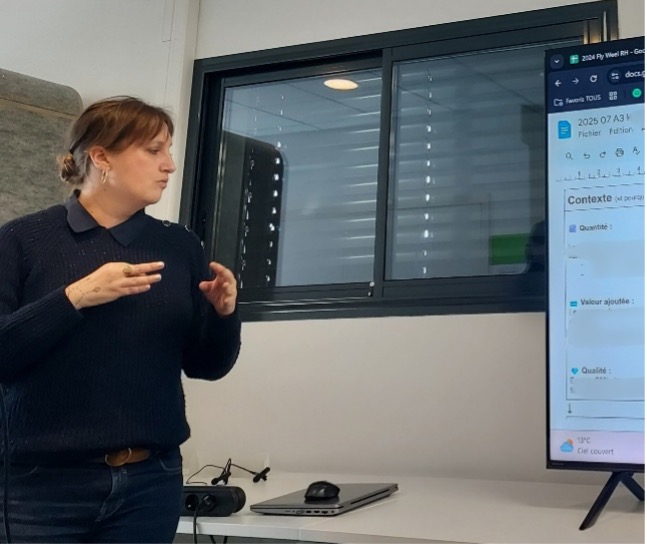
Jonathan, with whom we’re debriefing on the day, shares one final thought: “Every week, our executive committee meets. I ask them to agree on the two threats that will pose challenges for us in the short or medium term. It’s a great exercise in alignment, and our responses are becoming increasingly precise and comprehensive.”
JVWEB’s Toyota-inspired system helps it develop skills faster and deliver quality on time with less rework. But its real payoff shows up at the client’s table: it frees consultants to listen and propose, and it makes small clients profitable to serve. The next test, as Aymerik points out, is whether the same discipline can be applied to services that are still being invented, as platform automation reshapes the standard work JVWEB has mastered.

Read more


FEATURE – In the second article of our series written by the front-line staff of Siena University Hospital, we learn how the lean principles of pull and flow have transformed the blood donating process.

COLUMN - For her latest column, Sari Torkkola describes the initial steps that must be taken to move towards becoming a lean CIO and warn us against some of the pitfalls along the way.

FEATURE – Reflecting on the transformations he has supported, the author provides a few recommendations on how to get products to market faster.

FEATURE - In this essay, first appeared in his book Gemba Walks, Jim P. Womack describes the benefits of launching lean in a greenfield environment drawing from his experience volunteering in Central America.
Read more
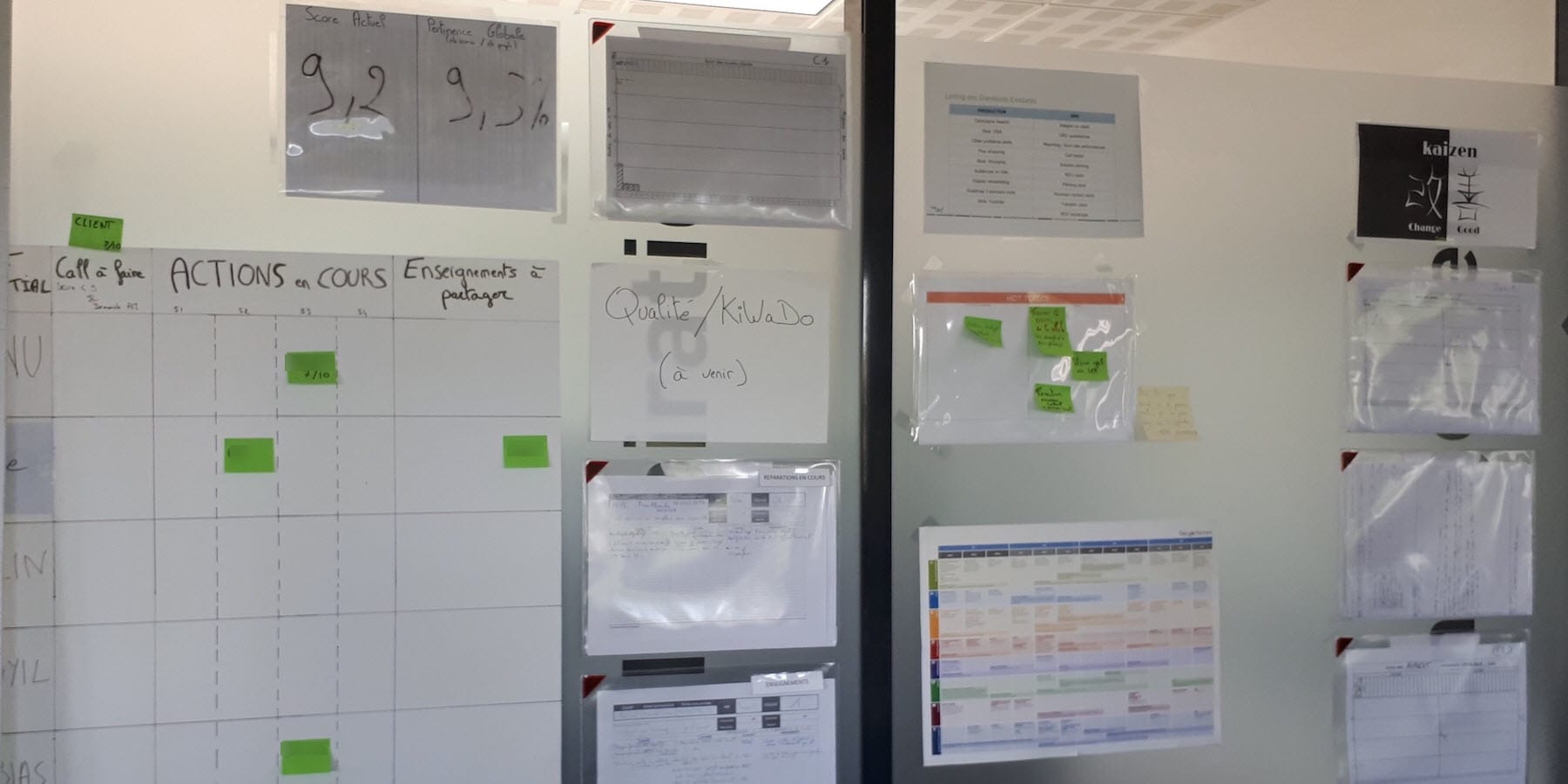
NOTES FROM THE GEMBA – In the web marketing world, a competitive advantage is a matter of life and death for businesses. The author meets a firm that has been leveraging lean to gain one.

NOTES FROM THE GEMBA – The author visits the Parisian airport of Orly to learn about a pilot project (pun intended) that aims to tackle the late departure of flights using lean thinking.

NOTES FROM THE GEMBA – At FC Versailles, a French third-tier soccer club, two former retail executives are building stability (in infrastructure, finances and team) as lean’s very first step.
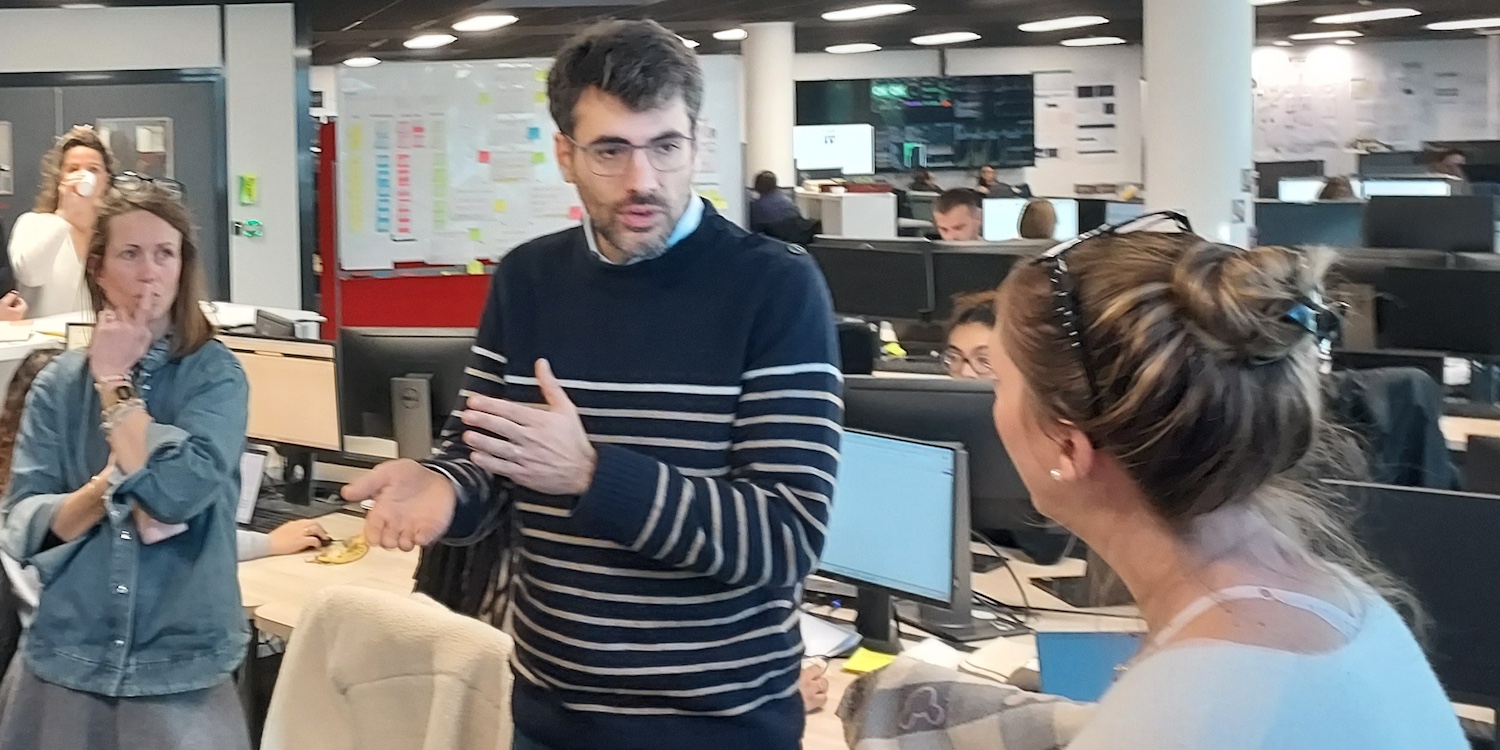
NOTES FROM THE GEMBA – This story shows how gemba visits and structured problem solving help teams at this e-commerce company uncover real problems, build autonomy, and improve decisions.