


Lean value networks in France
NOTES FROM THE GEMBA – The author explores how France’s Lean community evolved through gemba practice, kanban-driven engagement, communities of practice, and a flywheel model turning shared learning into momentum.
Words: Catherine Chabiron
How can we foster and promote a community of ideas, such as Lean? Can TPS help us do this? Today, I am embarking on a gemba that will help me shed a light on this subject, which I am eager to discuss with a few members of the lean community in France. In short, the idea is to partake in some genchi genbutsu: see for myself how far we have come and understand the thinking underlying our community’s approach.
To initiate a movement, you need pioneers who experiment with a concept (Toyota) and others who see them do it. For example, Freddy Ballé, co-author of The Gold Mine and formerly at French car manufacturer Renault, was surprised to see Toyota displaying such productivity and decided to go take a look. Similarly, Jim Womack and Dan Jones began to identify the concepts and practices underlying Toyota’s superior performance and described them in The Machine that Changed the World. We all know this.
But how do we move from observation to practice? And once we have started experimenting, how do we convince others? How do we develop a movement of ideas, such as a lean community, within a compaby, region, or country?
STARTING A COMMUNITY OF IDEAS
"In France, Freddy showed us the way in the automotive industry," recalls Michael Ballé, his son. "His groundwork at Valéo and then at Faurecia, two automotive equipment manufacturers, generated a first generation of sensei who were directly exposed to the practice of TPS in manufacturing plants." Michael took over and supported leaders on the gemba, while producing a theory of Lean Management in the form of books and articles. Learning had already started thanks to a growing international group of practitioners and students, and a first community of ideas was soon born in France (a lean institute).
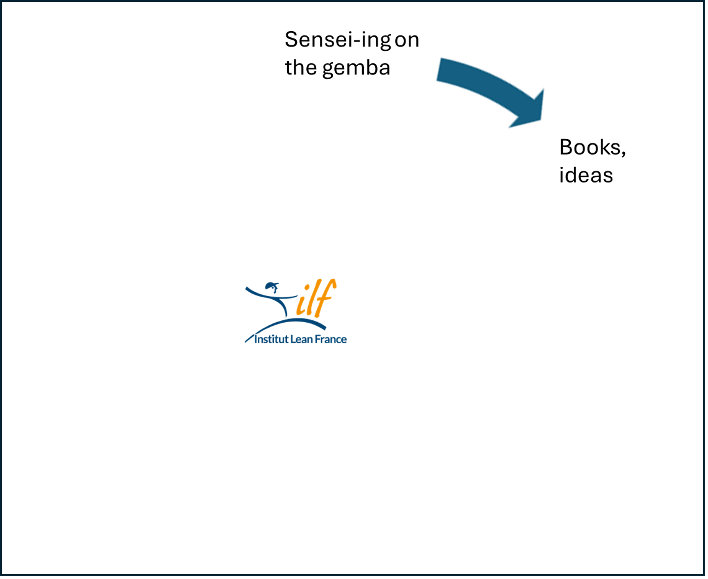
The institute started out by offering a few basic training courses, but above all a Lean Summit. I discuss this with Richard Kaminski, who very quickly took charge of managing Institut Lean France (ILF). "Remember our initial mistake," he tells me. "We initially thought that the success of the Lean Summit could be measured by the number of participants and the results we achieved. But we have since changed our minds: the real purpose of the Lean Summit is to highlight and showcase leaders who practice Lean. To share their experiences, tell their stories and inspire others, of course, but also to support and strengthen them when they go against the grain of dominant financial approaches. They are the real customers of the Lean Summit!"
The first generation of sensei, followed by “converted” French leaders, thus began to reinforce the theory of Lean with their real-life experience, recounted in conferences, masterclasses, and books.
IMPLEMENTING PRODUCT PLANNING
With so much educational events on offer, it became important for us to apply what we are teaching others, So, in 2018, I proposed a levelling board to plan the availability of the Institute Lean France products throughout the year.
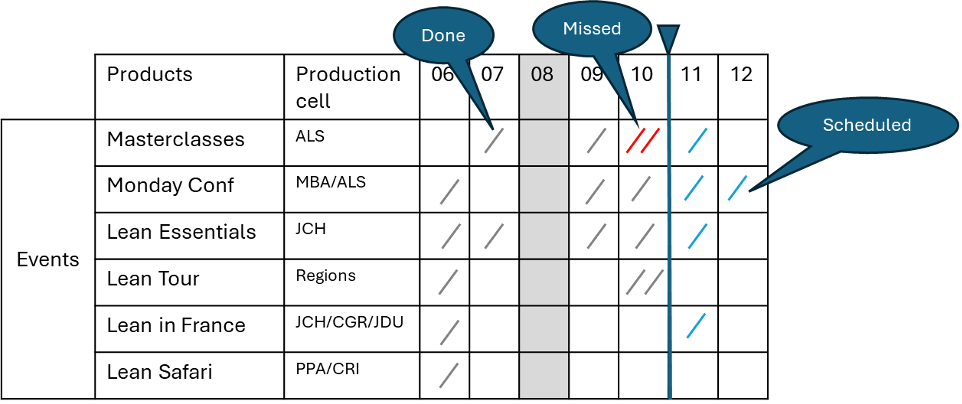
My initial idea was to level out the effort necessary to create these products and make them available to our audience, but this work also allowed us to start identifying volunteer production cells that would help us spread lean ideas: events, regional communities, masterclasses. These cells are encouraged and supported by a central event management system.
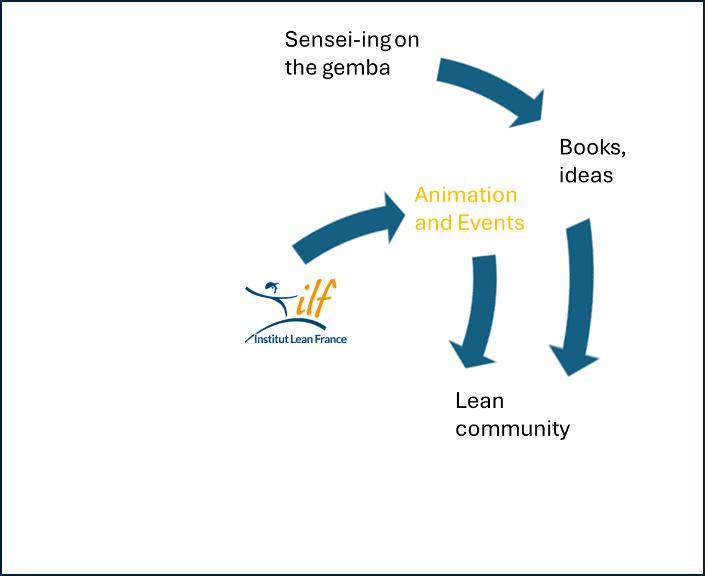
However, the ILF office quickly realized that the Lean Community is not naturally proactive: it receives (information, books, invitations to participate in events) but does not always engage. We had to energize it, keep it active, and find a way to even make it militant.
EMBOLDENING THE COMMUNITY WITH KANBAN CARRIERS
The idea of kanban carriers grew out of the kanban we were already using to launch masterclasses and other lean events. As we discussed the need to talk about Lean every day, across all available channels, someone suggested extending the concept beyond events—to help energize and activate the community itself.
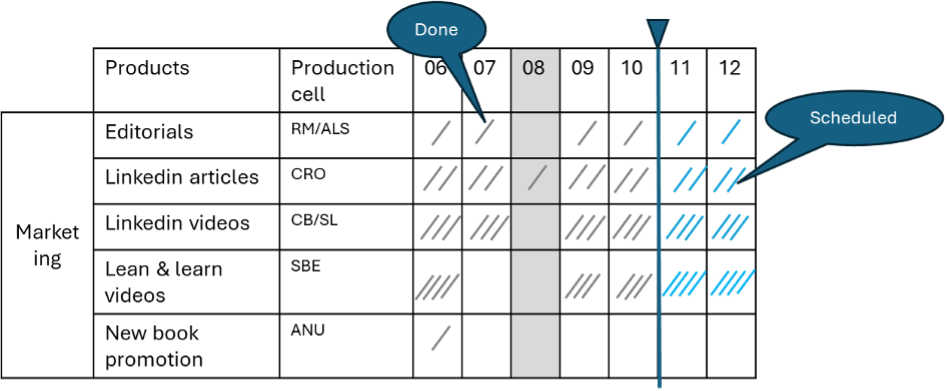
Anne Lise Seltzer, currently leading ILF, explains: “Today each of our five kanban carriers, who are institute members, have a distinct role—one distributes articles, another highlights lean glossary terms, and the others share video testimonials from lean leaders, books, or content for the newsletter. All of this is done following a steady schedule (takt).” Instead of asking the entire community to spread the word about Lean (it never works), the kanban holder asks a specific person each week to do the job (by passing them the production kanban) and then moves on to another member the following week.
The dissemination takt ensures continuity of communication, but the effort is spread across fifty or more volunteers. The kanban carrier relays the communication to other members of the community so that the information can be reposted, liked, shared, disseminated, etc.
Charles Bert, who carried the kanban for lean leader video testimonials for two years, talks about it: "This kanban allowed me to exchange with a large number of lean practitioners, discover ILF videos I didn't know about, learn new things and also develop my network. The benefits largely outweigh the time investment!"
The person responsible for the kanban does not just send a signal: they assist the volunteer who must communicate in the form of a post or article, clarify the key points to get right and help them develop skills in terms of the format, clarity and relevance of the message. A real dojo for communications.
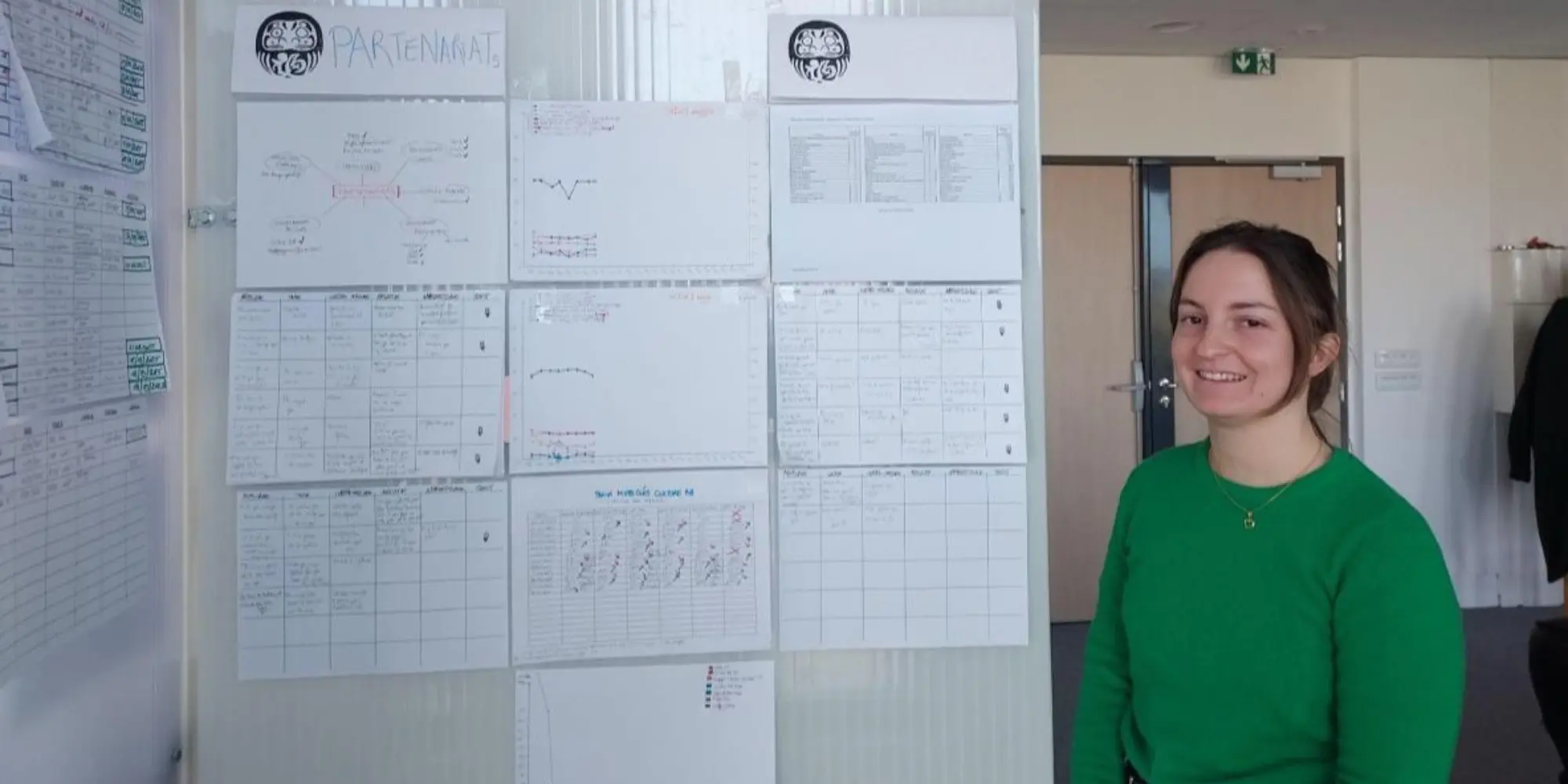
The kanban carrier, who regularly repeats this process, refines it continuously. In the image below, for example, you can see the evolution of the material created by Arnaud Nuret, who is responsible for promoting newly published books.
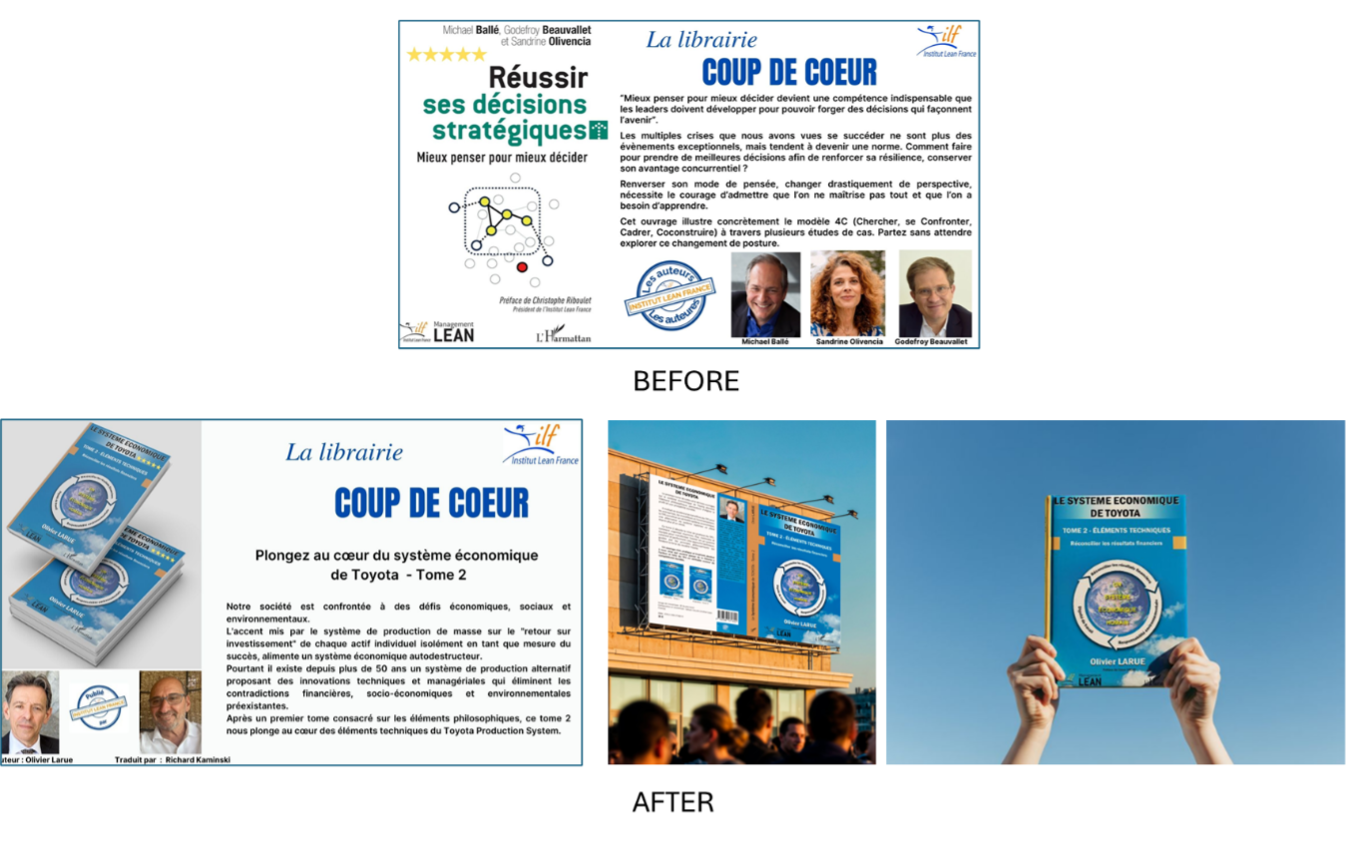
It is this genuine marketing work on lean products that encourages, motivates, and builds support. These takt-based marketing efforts across multiple streams paid off—making the Lean Community increasingly engaged and active.
GROWING A COMMUNITY OF IDEAS
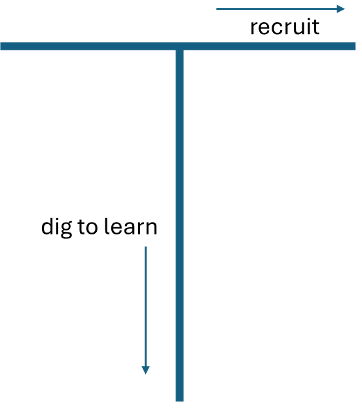
There are two ways to grow a community of ideas: we can increase our numbers, of course, but we can also improve what we know and how we talk about it.
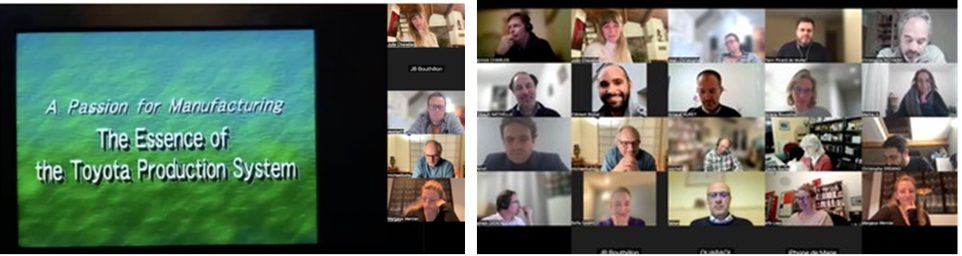
Julie Chevalier co-hosts a monthly webinar with Michael Ballé on the Essentials of Lean, a series of videos on the history of Toyota that illustrate its many facets and principles (product engineering, just-in-time, jidoka, collective intelligence and learning, etc.) and stimulate discussion and reflection.
“Lean is already an old brand, so we need to constantly return to its source to rediscover its original intent and move beyond the catalogue of tools to which it is often reduced,” Julie explains. The cycle begins again each year, allowing participants to see and review the concepts of TPS or the Toyota Way through original or more recent videos and documents. The atmosphere of the webinar is informal and the content is rich. It strives to provide the keys to the lean system. Julie sees two other advantages. “We also want to show that this is not a top-down training program but a collective learning process, with questions generating reflection, surprise at the often coiunterintuitive nature of Lean, and potentially further questions. It also helps to create a community of ideas that develops because it learns together, regularly, to see the original gemba, even if this is done digitally,” she explains.
She stops to think for a few more seconds and adds: “Everything is there already, in these historical videos. The problem is not that Lean is not explained to us, it's that we no longer know how to look.”
COMMUNITIES OF PRACTICE
As I prepared this article, I simply had to visit our oldest community of practice, the Lean Engineering Academy, which has been operating for over 15 years. Its 30 lean enthusiasts meet every month to experiment with lesser-known aspects of lean product design. Seventy percent of them have been coming back for several years—some from the tech sector, others from industry.
When I visit, the community’s monthly meeting is taking place at Focus Création (designer) and Theus Industries (manufacturer), a high-end stove and brazier business, in Cavaillon, southeast of Avignon. Each session is hosted at the site of one of the participants, who is then able to show the group their own experimentation with the concepts discussed throughout the year.
The day is a mix of theory, group work, and gemba. Michael Ballé, who leads the session, starts by explaining Toyota’s unique approach to product planning. The importance of marketing is discussed, and one participant comments: “If you market well, you can sell at a higher price.”
“No,” says Michael, “the selling price is set by the market. Product positioning and pricing are defined at the product planning stage, not by marketing.” Inevitably, the discussion turns to cost control: “What did Taiichi Ohno say? Control your costs. Do genka taigen: develop people to bring out the right product at the right cost.”
Later on the same day, the gemba walk allows us to come back to the subject: Matthieu Gritti, the CEO of Focus and Theus, has developed a product obeya that provides a real vision of their product range: which product for which use and what motivation. Concept papers show the thinking behind new product development, including key performance expectations (such as cost control) and technical issues to be resolved. Matthieu also takes us out to the plant to look at several kaizen projects in progress, including one on a product that needs stabilizing: previously electricity-powered, this stove is now battery-powered, but the electronic components are draining the battery prematurely.
At the end of the day, Michael leads a round table discussion during which everyone shares what stood out for them. This is a way of revisiting each of the topics discussed, reformulating them in your own words to better understand them.
Inevitably, before everyone leaves (in this case, in the pouring rain), this type of day ends with an invitation to talk about what was learned on social media. “Become cool, funny and interesting influencers,” Michael encourages the team.
Several lean communities of practice are developing in France around a particular profession—lean engineering, support or service functions, IT or industrial production—while others are regional. The communities are growing, as is the number of alumni (an alumni community also meets once a year).
THE LEAN BUZZ
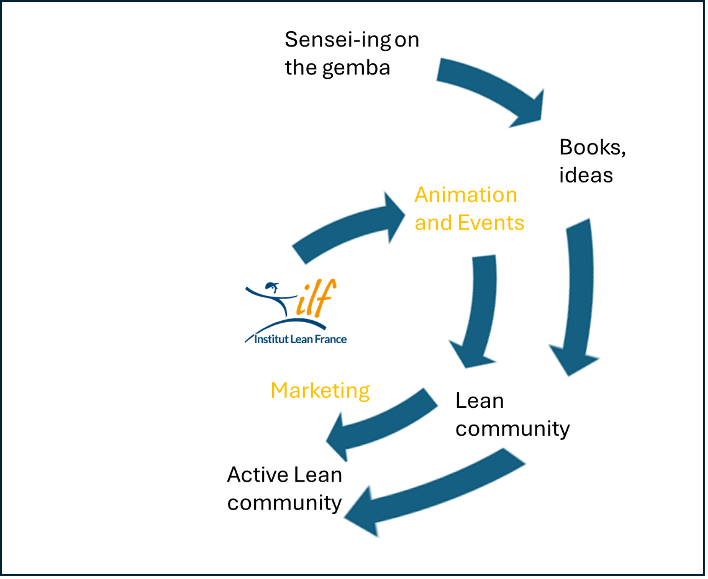
The buzz on social media, driven by members of all these communities, draws on lessons learned at the gemba and stems from the sharing of memorable testimonials, ideas, articles or book pages. This daily buzz in turn helps to highlight people who share their experiences or open their doors to other practitioners, such as lean officers, managers and CEOs.
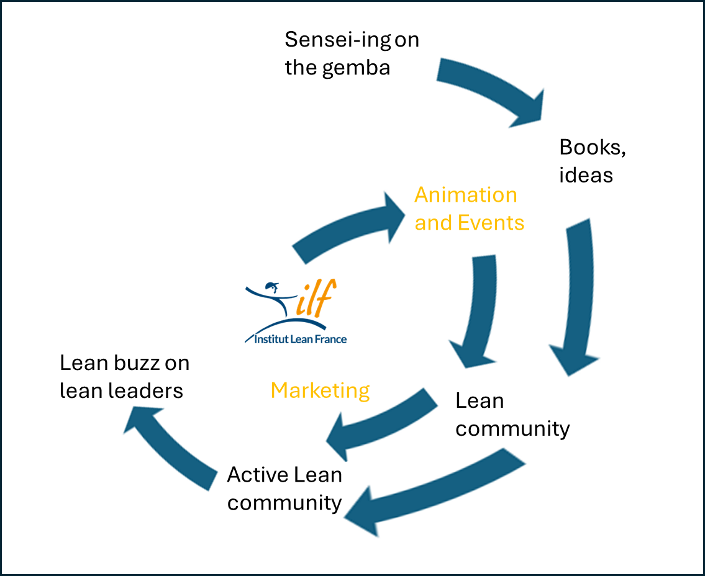
In turn, the lean leaders highlighted in articles, books or social media posts are contacted by peers, who have lots of questions and are often eager to go to see them, discuss, read. Ultimately, they need help. This is an opportunity to learn with them, at the gemba, about new applications of Lean and about new perspectives. The leader learns, but the sensei learns too—and this completes the flywheel.
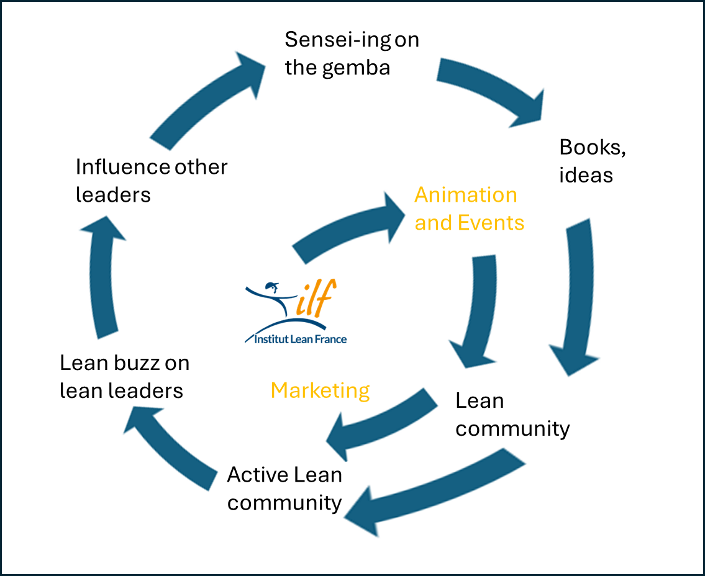
The flywheel concept was not invented by Institut Lean France. The best-known example was developed at Amazon. The idea behind it is to show that this wheel moves slowly at first, but that the groundwork carried out on each of its components allows it to turn more smoothly and faster. The development of a movement of ideas, like that of a customer base, is not a linear approach; it’s circular, feeding itself to create acceleration, but also risking slowing down if any one of the components stops working.
The flywheel I used in this article shows how a series of interactions can bring tangible and intangible benefits to an organization or, in this case, to a community of ideas (this is the very definition of a value network). But it is up to each of us to help the wheel turn every day.
THE AUTHOR

Read more


INTERVIEW – How many times have you been asked, “What is the ROI of lean?” Jean Cunningham provides her insight to help you measure the financial impact of your lean improvements.

FEATURE – Our coverage of the Covid-19 emergency continues with an article discussing how lean healthcare principles can support and protect the professionals at the front line of this war.
PROFILE – Before anything else, a good lean leader must be open to changing and continuously running experiments – something Christophe Riboulet, CEO of a small French manufacturer, knows quite a bit about.

NOTES FROM THE GEMBA – By renewing its focus on value and turning the gemba into a place for learning, Veolia Eau France is improving safety, efficiency, and customer satisfaction. (Part 1 of 2)
Read more

NOTES FROM THE GEMBA – The author visits a private engineering school to learn about their approach to teach Lean Thinking and apply it to their own work.
NOTES FROM THE GEMBA – This article explores how Sodebo’s leaders use TPS to scale craftsmanship, improve flow, and strengthen consumer focus across operations.
NOTES FROM THE GEMBA — This French tech firm thrives through Lean Thinking, continuous learning, and customer-focused innovation, embodying Toyota-inspired resilience in software development.

NOTES FROM THE GEMBA – Somfy’s R&D department is applying Lean Thinking to close knowledge gaps, improve collaboration, and boost innovation and technical competence.